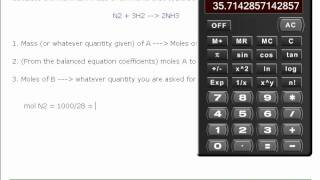
A short tutorial by Charles Collingwood showing a mass-to-mass stoichiometry calculation: find the maximum mass of ammonia producible from 1000 g of nitrogen (N2) assuming excess hydrogen. The speaker converts 1000 g N2 to moles (1000/28 = 35.7 mol), uses the balanced equation mole ratio (1 N2 → 2 NH3) to get 71.4 mol NH3, then converts to mass using Mr(NH3)=17 to obtain the ammonia mass (71.4 × 17 ≈ 1213.8 g). The video outlines the three-stage procedure (mass→moles, mole ratio, moles→mass).
Questions this video answers
1000 grams of N2
28 (2 × 14)
35.7 moles (1000 ÷ 28 ≈ 35.7)
1 mol N2 → 2 mol NH3
71.4 moles (35.7 × 2)
Chapters
Okay, here's an explanation for the question. You want to make the maximum mass of ammonia possible from a thousand grams of nitrogen. So you've been given the starting material nitrogen. N2, you can see that there. Nitrogen, one particle plus three hydrogen make two ammonia particles. So we focus on the nitrogen. The first thing we must do is work out the number of moles of nitrogen. We do that using the relative mass. The relative mass of nitrogen. Well, we have here nitrogen relative mass of 14, But there are two nitrogen particles. So the relative mass is 24. So to convert the amount of nitrogen we've been given to moles, we must divide by 24. So we have moles of nitrogen equals 1000 divided by. I said 24. I meant 28. 214 of 28, of course. Okay, what does that come to? Well, simply a calculator. Take the calculator. One naught, naught, naught. 1,000 divided by 28, that comes to 35.7. Alright, 35.7. So we have 35.7 moles of nitrogen. The next thing is stage two. Look at the balanced equation coefficients. Well, that means the numbers that are used to balance the moles in the equation. In this particular case we can see here there's one nitrogen. Three hydrogens make two ammonias. Well, we're only interested in the nitrogen and the ammonia. We're assuming there's enough hydrogen. So from this, however many moles of nitrogen we've got will have twice the number of moles of ammonia. Well, so this means that we want twice 35.7. So moles of ammonia equals 35.7 times two. You can use your calculator for this if you want. Or you can go straight to 71.4. 71.4 moles. So we've fulfilled stage one with turn the first component into moles. We've fulfilled stage two. We've looked at the moles equivalent of what we want to find. Now we've got to go to stage three. We're going to turn our moles of ammonia back into the quantity we were asked for. We're asked for the mass of ammonia. Alright, so we must convert moles to mass. Or to convert moles to mass, we have to use mass equals moles times relative mass. Well, the relative mass is ammonia. Well, ammonia is nitrogen, which is 14 and three hydrogens. 17. So it's 71.4 times 17. We can't work that out. Calculator 71.4 times 17 and that comes to 12, 13.8 grams. So to summarize we take whatever component we're interested in. In this case, nitrogen. We convert the information we're given into moles. Then we look at the moles equivalent in the equation, and then we take the moles of the product or the stuff we want, and then we convert it back to the quantity we want. One, two, three stages, and that's about the size of it.