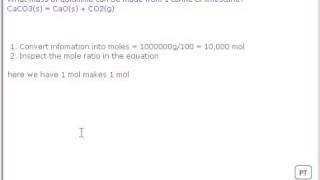
Charles Collingwood works through a mass-to-mass stoichiometry problem: converting 1 ton of limestone (calcium carbonate) to quicklime (calcium oxide). He converts 1000 kg to moles using RMM, applies the 1:1 mole ratio from the equation, then converts back to mass to get 560 kg of product.
Questions this video answers
560 kilograms
10,000 moles
100
Calcium = 40, Oxygen = 16 (CaO RMM = 56)
Chapters
Okay, here we have a question how to work out the mass of a product from a reaction. We want to know what mass of quicklime, which is calcium oxide, can be made from one ton of limestone. So the first thing to do, which is the same as we always do for all of these questions, is we take the initial information, which was one ton of limestone, limestone's calcium carbonate, and we convert that into moles. To do this, we divide by the relative molecular mass. So stage one, step one, we convert, convert information into moles. Now, to convert information to moles, we have to divide by the relative molecular mass. So in this particular case, it's one turn, which is 1000 kg times 1000 makes it into grams, 1000 grams divided by 100, which is the relative mass. And you can see that gives us 1, 2, 3, 4, 5, 6 noughts. Two noughts. So we end up with 10,000, 10,000 moles. Now, the next stage is to lift, look for the moles equivalent from the coefficients of the equation. So the coefficients of the equation are. If we have a look at this, our coefficients. Well, was one. Calcium carbonate makes one quick lime. So that gives us our ratio. So we inspect the mole ratio in, in the equation. And we can see in this particular case, we've got here, we have. Here we have one mole makes one mole. So therefore there must be the same number of moles of calcium oxide. Therefore, moles of calcium oxide equals 10,000 as well. Now, the last stage, which is what we always do once again, stage three is we convert moles back to whichever quantity we require. So we convert moles to mass. And to do this, we use the relationship that the number of the mass is equal to the moles times the relative molecular mass. So don't forget our relationship here. Mass equals moles times relative mass. So we need to find the relative mass of calcium oxide. Yes, calcium oxide. Well, to do this, of course, you would just use a periodic table. Periodic table. Here we look at calcium. Calcium is 40 and oxygen 16. So 40 and 16 is 56. So our mass then equals 10,000 times 56, which we can see. The mass is equal to 5, 6 and 4 zeros, 5, 6, or in other words, 560 kilograms.