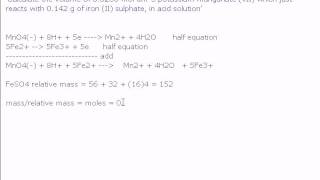
A recorded IB Chemistry worked example by Charles Collingwood that calculates the volume of 0.02 mol·L⁻¹ potassium manganate(VII) solution required to completely oxidize 0.142 g of iron(II) sulfate. The video derives and balances the MnO4-/Fe2+ redox half-equations, uses the 1:5 stoichiometry (MnO4- : Fe2+), converts mass to moles using an assumed molar mass for FeSO4 (152 g·mol⁻¹), and obtains a final volume of 9.35 mL. The presenter notes the answer assumes anhydrous FeSO4 and would change if the salt were hydrated.
Questions this video answers
0.02 mol·L⁻¹
0.142 g
152 g·mol⁻¹
0.000934 mol
1 MnO4- reacts with 5 Fe2+ (1:5)
Chapters
Okay, we're going to tackle this question. An A2 chemistry question. Calculate the volume of 0.02 moles per liter potassium manganate 7, which just reacts with 0.142 grams of iron sulphate. The first step is to write out the equation for the reaction. In case you didn't know, this is a redox reaction. The manganate 7 is the oxidizing agent. And this reacts according to the equation MNO 4. Put the charge in brackets. It's a minus charge in brackets. I didn't get the brackets. MNO4 plus what we need as many hydrogen ions as possible to absorb those four oxygens. So that's 8h. And this turns to manganese 2 plus and 4 water molecules. We can see here that this isn't balanced electronically. On the left hand side there are eight positives and one minus. That makes seven positives. On the right hand side there are only five positives. So we're going to cancel out five of the positives by putting in five electrons on the left hand side. And that's the half equation. Half equation for the behavior of manganate 7 iron when it behaves as an oxidizing agent. Now we want to know what the iron does. Well, we've got iron two, so we're talking about iron two. And this turns to iron three. And you can see once again the charges are not balanced. We need to put in one electron on the right hand side to balance the charges. So this is the half equation for the, For the iron. Now, when manganate 7 reacts with iron 2, we have to have exactly the same number of electrons. This means multiplying the second equation by five. I'm going to put in five here, five here and five here so that we don't have to write it out again. Okay, what we're going to do is we're going to add these together now. Add them together and simply this is going to give us the components we have here. Paste them in there. Plus the 5Fe2 iron. And on the right hand side we just add these together as well. Well, manganese 2 and 4H2O. I'm going to put them in here. That pesky magnifying glass. And 5Fe3 plus 5Fe3 plus. Okay, now we've got the mole equivalence. Let's have a look. Inspect it. Every one manganate reacts with five iron two plus. So however many moles of this we've got, we must have five moles of iron two plus ions. Well, let's inspect. Let's inspect the. Actually Question. We're told the volume. No, we're not. We've got to calculate the volume. Potassium permanganate, which reacts with a certain number of grams of iron 2 sulfate. Right. Okay, so we actually need then the relative mass of iron 2 sulfate. Now this isn't given in the question. So we'll have to assume that the iron 2 sulfate is just FeSO4. If it were a hydrated iron 2 sulfate, then we'd also have to include the water crystallization. But the relative mass then is the sum of all of the atoms. Well, iron. What's iron? Well, let's call it the periodic table. Have a look. Fe is. Where are we Fe? Fe is 56. 55.8. Sulfur 32, oxygen 16. Okay, so we're going to have to add up 56 plus 32 plus 16 and that comes to 56 and 32 is 88 and 1698 104. It's not 104. Of course it's not. We haven't multiplied the 16 by 4, have we? It should be plus 16 times 4. Of course. And that doesn't come to 104. Well, four 16s are 64. 64 and 32 is 96. 96 and 56 is 152. That seems more likely. Okay, so now we must turn the mass of iron 2 sulfate into grams. Sorry, into moles. So mass divided by relative mass equals moles. Okay, so the moles is equal to the mass that we have which is 0.142142 grams divided by the relative mass which we have as 152. What does that come to? Let's consult the oracle. 0.142. 0.142 divided by 152. And that comes to 0.000934. 0-point.000934. Okay, this is the moles of iron. Because if it's the moles of iron sulfate 1 iron sulfate provides 1 iron 2 ion. Now we look inspect the equation here. The equation tells us that every five iron two plus moles reacts with one. So the moles of manganate is the moles of iron divided by five. So it's the moles. Mno four minus equals moles Fe two plus over five. Well, what's that come to? That comes to 0.000934 divided by five. Alright, let's put into our calculator point 000934 divided by five equals. All right, so now that comes to 0.000187 to three significant figures, moles. Now we are asked to calculate the volume. So now we're dealing with the solution. So we have to look at the relationship. And the relationship, remember, is moles equals molarity times volume in liters. All right? So in other words, to get the volume, we must divide the moles by the molarity. Volume equals mole divided by molarity equals 0.000187 over the molarity, which we're given as 0.0202. Okay, let's call up the calculator. 0.000187 divided by 0.02. And that comes to 0.00935. Now, remember, this is in liters, and that equals. Multiplied by a hundred. Sorry, a thousand equals 9.35 ML. So the answer is the volume which is required to react with 0.142 grams of iron.2 Sulfate in acid solution is 9.35 milliliters. As I said, remember, we've made an assumption here. We've assumed that the iron sulfate is not hydrated crystals. This is not normal. We're much more likely to find that it's a hydrated salt, in which case the relative mass will be different and the final answer will be different. However, for the moment, this is the method that you would use.