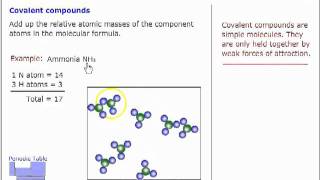
Short instructional video explaining how to calculate relative atomic and molecular (formula) mass using the periodic table. The speaker distinguishes between monatomic elements (treated by relative atomic mass) and simple molecular/diatomic elements (treated by relative molecular mass), and works through examples: magnesium, hydrogen (H2), ammonia (NH3), and nitrogen (N2).
Chapters
The relative mass of the elements can simply be found by looking at the periodic table. But we always need to take into account the nature of the bonding of the elements. In the simplest cases, most of the elements are treated as though they are monatomic. That is, they've got one atom in their smallest unit. For example, the metals, such as magnesium, even though they're giant structures, we treat them as though they're individual atoms. So magnesium, if we wish to know the relative mass, well, we simply look at the periodic table, find magnesium, and it has a relative mass of 24.31 or 24 for approximate purposes. So we can record the magnesium atom relative mass as being 24. Notice as it's considered to be atomic, it's called the relative atomic mass. However, there are a fair few elements, approximately 10, that are treated as though they are simple molecular, because this is how we believe they are. Hydrogen, for example, seems to have two atoms in its molecule. So if we wish to know the relative mass of hydrogen, we're not dealing with the relative atomic mass, we're dealing with the relative molecular mass. If we look at the periodic table, we find that hydrogen has got the relative mass of 1.01, or approximately 1. As there are two hydrogen atoms in a molecule, we multiply this one by two to get a total of two. And now we say that the relative molecular mass of hydrogen is 2. All of the diatomic elements are either gases or from Group 7. So Group 7 includes bromine and iodine. To find the relative mass of a simple molecular substance such as ammonia, we need to consider the formula of ammonia. Ammonia's got the formula NH3. And as we can see, one ammonia molecule has got one nitrogen and three hydrogen atoms. So to find the relative molecular mass of ammonia, we need to look at the relative masses, atomic masses of nitrogen, which is 14, and hydrogen, which is 1. So one nitrogen atom with a mass of 14, three hydrogen atoms, each with a mass of 1, makes a total relative molecular mass of 17. One more example, another element which exists as diatomic molecules is nitrogen. Nitrogen has a formula of N2. There are two atoms in the molecule. So to find the relative molecular mass of nitrogen, we need to consult the periodic table. Look for nitrogen, and we'll see the relative atomic mass of nitrogen is 14. So the relative molecular mass of nitrogen 2, 14 is 28.