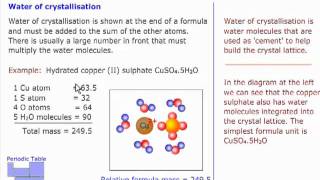
Short instructional transcript explaining that waters of crystallization are integral parts of hydrated ionic crystals and must be included when calculating relative formula mass; uses hydrated copper(II) sulfate (CuSO4·5H2O) as the worked example and reports a relative formula mass of 249.5.
When an ionic substance contains water crystallization, the water molecules are an integral part of the crystal lattice. They are used to build up the crystal lattice. This doesn't mean that the lattice is wet. It just means that the water molecules have been used as a kind of cement to build the structure of the lattice. For this reason, when we find the relative formula mass of a hydrated ionic substance, we must take the water molecules into consideration, because we can't weigh out the ionic substance without the water molecules. Now, this is expressed in the chemical formula. If we have a look at the formula for hydrated copper sulfate, for example, you'll see that along with the formula for copper sulphate CuSO4, there is another part which says 5H2O. This follows the formula of the copper sulphate. After a dot, the dot signifies that the water molecules are associated with the copper sulphate. Now, this means that when we calculate the relative formula mass, we have to add in five water molecules for each copper sulphate unit. So to calculate the relative mass, we must look up copper, sulfur, oxygen, hydrogen. Using the periodic table, copper has a relative atomic mass of 63.55, approximately 63.5 sulfur 32, oxygen 16, hydrogen 1, and of course oxygen 16. Again, this then allows us to calculate the relative formula mass of the hydrated copper sulphate. It has one copper atom, one sulfur atom, four oxygen atoms, and five water molecules. Remember, when I say copper atom, I really mean copper iron. But a copper ion has got the same mass as a copper atom. When we add these up, we get a total mass of 249.5. So the relative formula mass of hydrated copper sulfate is 249.5.