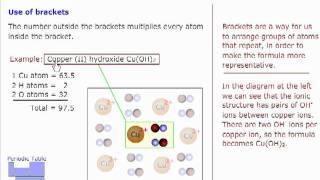
Short instructional video/transcript (Charles Collingwood) explaining how brackets in chemical formulas affect relative formula mass (RFM). Two worked examples are given: copper hydroxide (Cu(OH)2) with RFM calculated as 97.5, and ammonium sulfate ((NH4)2SO4) with RFM calculated as 132. Atomic masses used are Cu ≈63.5, N=14, S=32, O=16, H=1.
Questions this video answers
97.5
Copper ≈63.5 (or 63.6); oxygen = 16; hydrogen = 1
132
Nitrogen = 14; sulfur = 32
Chapters
Now, let's see how brackets in a formula affects the relative mass of the compound. In this particular case, we're going to have a look at copper hydroxide. Copper hydroxide is an ionic substance and as such exists as a giant structure of ions. However, the simplest possible ratio of ions within the structure, copper hydroxide, corresponds to one copper ion and two hydroxide ions. So the formula shows the two hydroxide ions in a bracket where there's a group of atoms that must stay together, as in the hydroxide ion, and these are multiplied, we put these in brackets. So that means that in order to find out the relative formula mass of copper hydroxide, that's the mass of the simplest formula unit, we need to look up copper, oxygen, and hydrogen. So, from our periodic table, copper has a mass of approximately 63.6 or 63.5. In some books, oxygen has a mass of 16, hydrogen has a mass of 1. And so we look at the formula. The formula tells us there is one copper and two oh groups. So copper, one copper atom has a mass of 63.5. Two hydrogen atoms have a mass of 2, and two oxygen atoms have a mass of 32. The total of all the masses is 97.5. And so the relative formula mass of copper hydroxide is 97.5. Now, let's have a look at another example. Ammonium sulfate. Ammonium sulfate is a giant ionic substance. It has the general formula, general formula. It has the chemical formula NH4 2SO4. This means that the simplest formula unit consists of two ammonium ions and one sulfate ion. So in order to find the relative formula mass, we need to look up nitrogen, hydrogen, sulfur, and oxygen and multiply them appropriately. We need to find the mass of one ammonium ion and then multiply it by two and add in the mass of a sulfate ion. So, looking at the periodic table, nitrogen has a mass of 14, sulfur has a mass of 32, hydrogen has a mass of 1, and oxygen a mass of 16. So in NH4 2SO4, there are two nitrogen atoms, there are eight hydrogen atoms. That's four times two. There is one sulfur atom and four oxygen atoms. When we add these together, we get 132. So the relative formula mass of ammonium sulfate is 132.