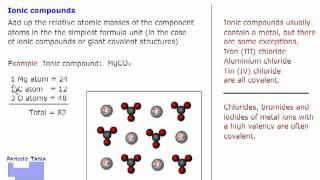
Short instructional video by Charles Collingwood explaining how to calculate the relative formula mass (relative formula mass) of ionic compounds by treating the chemical formula as the simplest formula unit and summing atomic masses from the periodic table. Two worked examples are given: magnesium carbonate (MgCO3) calculated as 24 + 12 + 3×16 = 82, and calcium oxide (CaO) calculated as 40 + 16 = 56. The speaker notes that ionic masses equal atomic masses for this purpose because electrons contribute negligible mass.
Questions this video answers
82
Mg ≈ 24, C ≈ 12, O = 16
56
Ca ≈ 40, O = 16
Chapters
To find the relative mass of ionic compounds is not really much more complicated than finding the relative mass of molecular compounds. We just need to understand that when we deal with a compound, we're looking for the simplest formula unit and this is exactly what's represented in the chemical formula. To take for example, magnesium carbonate. Magnesium carbonate has got a chemical formula MgCO3. You'll see that although the structure is a giant structure of ions of repeating magnesium and carbonate ions, the simplest ratio of the ions is one to one. There's one magnesium ion to one carbonate ion. And the fact that they're ions doesn't affect the relative mass of that particular formula. Because an ionic mass is very much the same as an atomic mass. They only differ in terms of electrons and electrons have a virtually no mass. So to find the relative formula mass of magnesium carbonate, we would have a look at the formula MGCO3 and use the periodic table to find the mass of magnesium, carbon and oxygen. So from our periodic table, magnesium a mass of approximately 24, carbon a mass of approximately 12 and oxygen a mass of 16. Hence we can add in one magnesium atom, one carbon atom and three oxygen atoms. This gives us a total relative mass of 82. And this is the relative formula mass of of magnesium carbonate. Let's look at another example, calcium oxide. Calcium oxide is also an ionic substance. It's a repeating giant structure of calcium ions, oxide ions in a three dimensional never ending array. However, the simplest formula unit is just one calcium ion to one oxide ion. The ratio is one to one. And so we write the formula CaO. Calcium oxide consists of one calcium ion, one oxide ion as the simplest formula unit. So to find the relative mass of the simplest formula unit of calcium oxide, use the periodic table. The mass of calcium is approximately 40. The mass of oxygen is approximately 16. Exactly 16. Hence calcium oxide CaO 140 plus 116 gives a relative mass of 56. Hence the relative formula mass of calcium oxide is 56.