IB past paper worked solutions - M11H2TZ2-5
Worked solution for an IB chemistry exam question on weak bases. Covers Lewis structures of NH3 and NH4+, pH calculation for ammonia solution, titration with HCl, buffer behavior, and how salts like Na2CO3 and FeCl3 affect acidity when dissolved in water.
Chapters
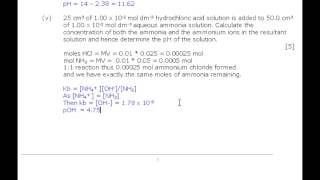
May 2011 High Level Paper 2 Time Zone 2 Question 5. Ammonia NH3 is a weak base. It has a PKB of 4.75. This is a question about weak bases. Ammonia is typical weak base. It's the one that is generally thought of as typical and often appears in questions. The first thing we have to do is draw the Lewis stretch of ammonia and state the shape of the molecule and its bond angles. Well, we can input the Lewis stretcher of ammonia here from the file Ammonia NH3. And what shape have we got for ammonia? Well, you can see there are four regions of electron density. There's a lone pair and three bonding pairs. And this means that electronically. Electronically it's tetrahedral. But of course, we can only see the bonding pairs. We can't see these. So that's, this leaves, they become visible. The bottom three bonding pairs here are visible. So these will be the bottom three prongs of a tetrahedral. And that leaves the molecule molecular shape. This was molecule trigonal, pyramidal. Now, as the bonds are based on a tetrahedron, they would normally have a bond angle. Tetrahedral bond angle is 109.5 degrees. Tetrahedral bond angle is 109.5 degrees. But due to lone pair. But lone pair bonding pair repulsion is greater than bonding pair. Bonding pair. Bonding pair, bonding pair proportion. Lone pair bonding pair proportion is greater than bonding pair bonding pair proportion. And this squeezes squeezing the bond angle down to 107 degrees. Specify the bond. There's only one bond angle here. It's the HNH bond angle down to 107 degrees. So we've fulfilled Lewis structure. We've stated the shape of the molecule and its bond angles. Well, we're told the conjugate acid of ammonia, Remember the conjugate acid is the acid that's obtained by addition of a hydrogen ion. It's the ammonium ion. So what we're talking about here is NH3 +H2O. We'll put in a pseudo equilibrium symbol here. Makes NH4 +. That's the ammonium ion + oh, minus this is the formation of the hydroxide ions by the interaction of the base ammonia with the water solvent. And just to format all of this, so this gives us our acid base reaction. Now we're asked to draw the Lewis structure of the ammonium ion and deduce its shape and bond angles. Okay, well let's go to the original shape here. If we capture a hydrogen ion, it's going to be captured by this lone pair of electrons. So we're going to get the shape of the electronically tetrahedral shape which will then become the shape of the ion. Let's put this in, insert a picture from the file and we'll put in the NH4. NH4. And you see it's exactly what's happened is the lone pair has picked up a hydrogen to give. It's a tetrahedral. Tetrahedral shape. Shape the bond a benond angle. A bond angle of 109 degrees 109.5 degrees. 109 degrees 28 minutes is you like. Another weak base is nitrogen trifluoride. Explain how nitrogen trifluoride is able to function as a Lewis base. Now Lewis bases. Lewis theory looks at the electron pairs and a Lewis base. Lewis base is an electron pair donor. Well, if we have a look at the shape of nitrogen trifluoride, you'll see it's got electron pair which it can donate and capture hydrogen ions. Okay, let's call up the molecule nitrogen trifluoride from the file and we'll see the nitrogen trifluoride has a lone pair of electrons. It's this lone pair of electrons that allows it to act as a Lewis base. This is a lone pair on the nitrogen on the N atom can be donated and the molecule behave as a Lewis base. As it's symbol's name we'll give it a capital L. And there's the answer. Probably a bit too thorough an answer looking at the fact there was only one mark for that. Okay, the next part then. We've got a calculation to do. Calculate the pH of 1 times 10 to the minus 2 mole solution of ammonia at 298Kelvin. Well, we're going to need the PKA of ammonia. We were told at the start of the question the PKA of ammonia is 4.75. Sorry, I said PK. I meant to say PKB of ammonia is 4.75. Alright, so that means that our equation NH3 plus water H2O which is an equilibrium waste, NH4 and oh, Tidy that up, put the coefficients in the right places and charges superscripts and that gives us K. Our KB expression is equal to two components divided by one component. Remember, it's the products. Divided by the reactants. And we ignore the water because water is in vast excess, it doesn't appear in the key, it's effectively constant. So it doesn't appear in the KB equation. Now then, one assumption we make is that because ammonia is only slightly interacting with the water, the ammonia solution stays the Same, so, same concentration. So now we need KB from PKB. We do this by taking the 10 to the minus 4.75, Which is of course 4.75 change sign antilog and it's 1.78 times 10 to the minus 5. 1.78 times 10 to the -5. I seem to, I seem to put that in the wrong place. KB 1.778 times 10 to the minus 5 was 4.75 there, 4.75. And now this when multiplied by the ammonia solution, which is 1 times 10 to the minus, so it's times 1 times 10 to the minus 2. And that equals the ammonium ion times the oh and both of these have the same concentration because they're formed when one of these breaks up or reacts. It makes one one of these and one of these. So these two must have the same concentration. So we can effectively write this as OH minus ion concentration squared. Okay, so having done that, where do we go? Well, we can see that if this is OH ion concentration squared, then all of our calculation on the left hand side put inside the square root of it, the root of all of this, the root of all evil. And we should be able to see that we're multiplying by 10 to the minus 2. So it's not actually difficult. That becomes minus 7. And we've done our calculation. So the square root of that equals the OH minus ion concentration. Let's just put it in the same line. So we take 1.7, so we've got the square root of that and it comes to 0.0.00422 to three significant figures. Well, we've got the OH ion concentration now, so we can find out the poh, which is minus log 10 oh minus ion concentration. Poh equals minus log oh minus ion concentration. Let's see, we just take the negative of the log of that and it comes to 2.38, 2.375, 2.38. Well, that means that the ph, The ph then is equal to 14 -2.38 and that equals 11.62. And there's the calculation finished. The next part of the question, we're told that 25 cm cubed of 1 times 10 to the minus 2 mole hydrochloric acid adds to 50 of aqueous ammonia. We have to calculate the concentration of both the ammonia and the ammonium ions in the resultant solution and hence determine the ph. So this is also another partially an acid basis question, partially moles question. First of all, let's Calculate the number of moles we've got of hydrochloric acid. So moles of hcl initially, of course, where that went to initially is equal to molarity times volume MV, which is 1 times 10 to the minus 2 0.01 molar, multiplied by 0.025 liters, and that comes to 0.000025. Is that correct? We should have five. Just one. Nothing. I've got too many, haven't I? 1, 2, 3, 0.00025 moles. Now, we want to have a look at the moles. Ammonia. Moles of ammonia. Again, molarity times volume. The molarity of the ammonia, we're told, is also 0.01. We must multiply this also by its volume, which is 0.05, and that comes to 0.0005 molar. Now, hydrochloric acid reacts in a one to one ratio. It's a one to one reaction. Thus, the larger of these two, which of course is. The ammonia, is in excess. So all of the hydrochloric acid turns to ammonium chloride. So we have 0.00025 moles of ammonium, ammonium chloride. Chloride formed. And how much ammonia do we have left? Well, we have 0.005 minus 0.0025. We have exactly the same. And we have exactly the same moles of ammonia remaining. Now, if we look at the relationship for kb, KB equals. I think, let's take it from earlier on. We've got the KB expression somewhere, haven't we? Of course we have. There it is. KB expression. KB is ammonium ions, hydroxide ions over ammonia. Well, we're told the ammonium ions are exactly the same as the ammonia remaining. In other words, KB is. Oh. So as. See if we can write this correctly. As that equals that, Then. KB equals. Oh, quite handy because we know what KB is from earlier on as well. We found KB as 1.78 times 10 to the minus 5 copy equals 1.78 times 10 to the -5. So from this, then poh, POH equals. We put 1.78 times 10 to the minus 5. 1.78 exponential minus 5. Take the log of that and we get 4.75, 4.75, which means the phone equals 9.25 14 minus 4.75. Next part of the question. This seems to be an amazingly long question. State what is meant by a buffer solution. Buffer solution is a solution that resists change in ph on addition of small amounts of either acid or base. That's our definition of a buffer solution. Explain how the solution in Part 5, which contains ammonium chloride dissolved in ammonia, can function as a buffer. Okay, for this, the best way to do this is to look at our equilibrium. Let's take the equilibrium reaction which we have got somewhere back here. Here it is. Here's the equilibrium react. So from this, then small additions, Small addition, additions of acid are absorbed by the large reservoir of ammonia present. It's because ammonia only, remember ammonia, ammonia only partially dissociates. Small additions of base. Are. Absorbed by the large reservoir of ammonium ions present from the salt. And so OH pushes the equilibrium to the left hand side and H pushes equilibrium to the right hand side. As there's a lot of NH4 and a lot of NH3, then we virtually always maintain the oh ion concentration. Next part of the question. Salts may form neutral, acidic or alkaline solutions when dissolved in water. Explain why solution sodium chloride is neutral, but sodium carbonate forms an alkaline solution when it dissolves in water. Okay, so with nacl, nacl, neither of, neither of the ions interact appreciably with water molecules. But with na2co3, The carbonate ions, the carbonate ions are weakly. Acidic. Well, weekly basic, aren't they? Sorry, weekly basic. And interact with, with the water molecules as such. Let's put them in CO3. Co 32 minus. Plus h2o. Let's get our insert equilibrium symbol goes to h co3 1. HCO 3 minus + oh, so it produces hydroxide ions. This is the conjugate acid hydrogen carbonate ion. So this is the base carbonate ion interacts with water molecules producing the OH minus ion. And this makes sodium carbonate basic. The iron three plus iron iron chloride. Well this, this is the, this is the hexa aqua iron three plus hexa aqua iron. This is a slightly different mechanism. What happens? The high charge charge dense density of the iron three plus iron polarizes the O H bonds of the water ligands. This weakens them and allows hydrogen ions to be removed by other water solvent. Now we can put this down in terms of an equation. Sometimes it's requested in the form of an equation. So let's put it down anyway plus H2O and we'll give it our insert symbol. Now what we do is we lose a hydrogen ion from this, making H2O5. Oh, and this is now a 2 +ION +H3O +. So this is the protonated water molecule hydroxodium ion. And this shows how the acidity is being created. And so it's due to the high charge density on the iron 3 iron which polarizes and weakens the bonds in the water ligands. Finally we have to state the equations. For reaction sodium oxide, Na2O and phosphorus with water Na2O plus let's borrow an H2O from here. This isn't an equilibrium it's a direct reaction and it makes two Naoh this is why sodium oxide dissolves in water to form a basic solution P4O10. Adding this to water as well in this case we're making an acid H3PO4. Phosphoric 5 acid. It needs balancing we want three hydrogens. Can't have three hydrogens we want to have two of those we want to have three of those and now two H3PO4 oh sorry we're going to double it again we want four of those to get four phosphoruses we want six of those and that should be about right 4:04 166 and 1016 for the oxygens everything's correct.










