Indicators 01
Charles Collingwood teaches acid-base chemistry: Bronsted-Lowry definitions, weak versus strong bases like ammonia, and how to read titration curves. He shows how to find pKa at the half-equivalence point (around 4.75-4.8) and pick the right indicator, phenolphthalein, for a 0.1 M ethanoic acid titrated with KOH.
Chapters
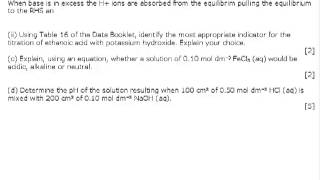
IB Pass Paper Question May 2011 High Level Paper 2 Time Zone 1 Question 8. Define the terms acid and base according to the Bronsted Lowry theory. Distinguish between a weak base and a strong base and state. One example of a weak base. Right. There are three marks there. The first part is for defining the terms acid and base according to a Bronsted Lowry theory. Well, an acid is a proton donor. Remember, the Bronsted Lowry theory deals with acids from the point of view of hydrogen ions. So we could put hydrogen iron donor. By the same token, a base is a proton hydrogen ion acceptor. Distinguishing a weak base to strong base. The strong base or a weak base. First of all, a weak base is only partially. Dissociated in solution. This means that the weak base interacts only partially with water, that is interacts only slightly with water molecules. Strong bases interact 100% with the water solvent, Producing hydroxide ions. The third part of the question, one example of a weak base. Well, the classic example is ammonia. Ammonia solution is a weak base and we could exemplify it by the reaction or the interaction between ammonia and the water solvent. And as we said this put the symbol in here for equilibrium to indicate that the reaction does not go to completion. Therefore plus OH format that. So this equilibrium lies very much to the left hand side. So the majority of the ammonia does not interact with the water solvent. Okay, on to weak acids. Weak acids in the environment may cause damage. Identify a weak acid in the environment and outline one of its effects. Well, carbon dioxide is a weak acid. So what we're looking at here is carbon dioxide is a possible choice for this. Another possible choice is sulfur dioxide. Sulfur dioxide exists due to pollution, as does nitrogen dioxide. All of these are weakly acidic gases. Carbon dioxide effect on the environment. It causes global warming or it contributes contributes to global. Warming. That would be one effect on its environment. On the environment, sulfur dioxide contributes to acid rain and nitrogen dioxide also contributes to acid rain. But let's have something different. It contributes to to smog in pollution in cities. Because of course nitrogen dioxide is formed in car engines. There's three weakly acidic acids and each of them has an effect. Obviously for the two marks you only have to put one weak acid and one contribution. Alright. The graph below indicates ph change during the titration of 20 centimeter cubed of 0.1 molar ethanoic acid with 0.1 molar potassium hydroxide. From the graph, identify the volume of potassium hydroxide and the ph at the equivalence point. Okay, so we have to look for the equivalence point Here, let's take a vertical line and see where the line goes up. Exactly. Let's take a horizontal line. And let's see if we can identify them. Pretty much the midpoint there. Well, you can see that what we've got here is pretty close to 20cm cubed and the pH is somewhere like 8.7, 8.8 at the equivalence point. Let's put these values down. So 20cm cubed or 20ml of KOH neutralises the acid and the PH of the equivalence point. PH at equivalence point is 8.7. Explain how the graph could be used to determine the PKA of ethanoic acid and determine the PKA value for this data. Well, this is one of the interesting characteristics about these. At the half equivalence point, in other words, at 10. I'm just putting a line on 10 here. At 10. Well, the ph value is equal to the PKA of ethanoic acid. So the PH at the half equivalence point equals PKA of ethanoic acid. Or actually explain, maybe we should explain why this is so. Well, if you put in the KA of the weak acid, ethanoic acid, H plus, we'll just represent the conjugate base as A minus over ha. Well, if we take logs all the way through, we would get PK negative logs equals ph. Times, sorry, plus log, negative log. So it's minus minus log A minus plus log ha. Well, in fact, rather than doing minus log A minus, we'll keep a minus over ha together and we'll just say minus the negative log, minus log A minus over ha, that's log of all of this. I should specify that. Well, you can see that when A equals ha, in other words, the negative ion is equal to the acid, half of the acid must have been used up. So the point where half of the acid's been used up, this whole term becomes the log of 0, the log of 1, which is 0. So pk equals ph. And from our graph, then PKA of ethanoic acid equals. Well, what do we say that is 4.8, 4.75. The next thing we have to do. And I'm going to skip into here, insert break. Next thing we have to do is to sketch a graph similar to the graph on the previous page to indicate the change in ph during a titration of 25 mil of strong acid with that of KOH on your graph. Clearly indicate the starting ph, the equivalence point, the ph and the final PH reached. Well, we notice we've got the 25 mil of 0.1 molar and we're titrating with 0.1 molar. So the equivalence point, because it's a strong acid and a strong base, the equivalence point in this particular case will be exactly 25cm cubed equivalence point at 25mil base added. And the ph here, because it's a strong acid and a strong base, the ph will be seven. Final ph reached. Ph 7@ the equivalence point. If we keep adding base. Looking at our graph here, up to 50. We have to calculate the phone once we've added 50ml. So we've got 25mil in excess. So the moles excess of KOH will be equal to 0.025. That's the number of ML times 0.1 equals 0.0025. That's the moles in excess base total volume. At this point we've added 50 to 25 of the acid. That's going to be 75 mil which is equal to 0.075 DM cubed. So now we've got the concentration of the OH ions. So the oh minus ion concentration equals the mol 0025 divided by 0.075. Okay, let's bring this in then. 0025 divided by 0.075. This comes to 0.033. 0.033 moles DM moles per liter. So the POH value P POH is the negative log of that minus log 0.033. And that comes to well, 0.033. We've already got on the calculator here. Let's just take the log of that. It's 1.4 1.48 1.48. And now we know that the ph equals 14 minus poh. So that comes to 12.52. So our final ph is 12.52. Part B describe how an indicator works. Well, an indicator indicator is a weak acid or base whose conjugate has a different color. We can represent it by hin, it interacts with the solvent, Interacts with the solvent to give H+N minus. Each of these has a different color. So therefore when in excess acid, in other words high hydrogen ion concentration, the equilibrium is pushed to the left hand side and the color of the H in seen when base is in excess, the H ions are absorbed from the equilibrium pulling the equilibrium to the right hand side and the color of in minus C. Just going to drop that down a bit. So you can see this. I seem to have jumped up a little bit. We could also mention here that the midpoint of the indicator will be when there are equal amounts of both concentrations. So the midpoint of the indicator is seen with when the H in concentration is equal to the in minus concentration. Now, if we put this fact into the weak acid, which is the indicator of course equilibrium, we have H in minus over H in. We should be able to see that when hin equals in minus, then ka equals H. So when. Put H in equals this is the in minus concentration. Of course, in minus concentrations, H n concentrations N minus concentration comma ka equals H. In other words, PKA of the PKA of the weak acid, which is the indicator, is equal to the ph. So the ph at which the indicator changes, therefore the ph at which the indicator changes equals PK of the indicator. There's more than enough information there. This is just a bit of background theory which allows us to understand a bit more about indicators. Using Table 116 in the data booklet, identify the most appropriate indicator for the titration of ethanoic acid with potassium hydroxide. Well, what we're looking for here is we need to recognize that the ph is going to be greater than 7 at the equivalence point. Ph is greater than 7 at the equivalence point. So we need an indicator. So we need an indicator that changes between. 7 and 10. And the ideal choice here, phenol, phenolphthalin is the indicator of choice. Explain using an equation whether the solution of 0.1 mole per liter iron chloride would be acidic, alkaline or neutral. Well, in this particular case, we're talking about hydrolysis of the iron hexa aqua iron in solution. This is a complex ion with a triple three plus charge. And in solution, the high charge density of the iron 3 draws electron density away from the HO bonds in the water molecules. And this gives rise to an equilibrium this gives rise to an equilibrium between this and. This with a two plus charge as it releases hydrogen ions. So this shows that the iron three species releases hydrogen ions into solution, making it acidic. Now, I haven't actually explained this. I've just put the equation down. We could say verbally the high charge density, high charge density of the iron three Iron polarizes the O H bonds of the water molecules. Which are ligand to the, to the iron and weakens, weakens the, weakens them, allowing hydrogen ions to be to be released, released in solution. Okay, so we've got our two marks there. We have an explanation. We've used the equation and we've said that it's acidic. Final part of the question is another ph determination. This time we're adding hydrochloric acid, sodium hydroxide directly. So we need to know which is the limiting reagents. We work out the moles of each. The moles of moles of hydrochloric acid HCl equals molarity times volume. So molarity is 0.1. No, sorry. 0.0.5. The volume is 0.1. That gives us number of moles. 0.05 moles. Moles of sodium hydroxide. Again, MV molarity 0.1. Volume 0.2. 0.02 mol. So we should be able to see that there's excess moles of hydrochloric acid. It's a one to one reaction. But I make a note of this one to one reaction. Therefore, all, all of the sodium hydroxide neutralizes 0.02 moles of acid. So excess acid equals 0.05 minus 0.02 equals 0.03 moles. Total volume equals. What are we adding? 200 is being added to 100300 miles, which is equal to 0.3 liters. So the molarity of the acid concentration of the acid moles over volume, 0.03 divided by 0.3. And that of course comes to 0.1, Which is. Moles per liter. Ph. Then. PH equals minus log hydrogen concentration, which is minus log 0.1, which is equal to 1. Ph equals 1. That's the end of this calculation.










