Short instructional video explaining acid–base indicators. The speaker defines indicators as weak acids in equilibrium with their conjugate bases whose different colours depend on pH, derives the midpoint rule (colour change near pH = pKa), and gives examples (phenolphthalein, pKa 9.5; methyl orange, pKa 3.46) with guidance for choosing indicators in titrations.
Chapters
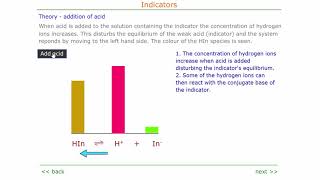
Okay, an indicator. An indicator is a substance that changes its colour according to the ph of the solution. They're not magic. They must be doing something chemically in the solution to do this. In fact, when we have a look at indicators, they are themselves weak acids that exist in equilibrium with their conjugate base. So if we look at the equation here, H in represents the indicator and this is in equilibrium in the solution with hydrogen ions and indicator minus ions, the conjugate base ions. Now the whole idea is that the indicator hin is a different color to the indicator minus ions. So according to equilibrium law, if we increase the hydrogen ion concentration, we push the equilibrium to the left hand side. If we decrease the hydrogen ion concentration, we push the equilibrium to the right hand side. Okay, let's have a little look at some ideas. So imagine we have our H in. Now it's a weak acid H in the indicator. That's an acid, remember weak acid. So as a weak acid, the majority of the particles in the solution will be H in. It won't be dissociated. So here we can see that I've put a large bar representing the number of moles of H in in the solution, for example, or the concentration if you like. There will be a small amount of H ions as well because there's some dissociation and there'll also be a small amount in minus ions. So the color we would see is predominantly at the moment in this position was predominantly H in molecules color. If we add acid though, we add H ions. Now initially the right hand side increases and this disturbs the equilibrium. So the equilibrium then pushes to the left hand side and it ensures that what we actually see is the H in. So the idea of adding hydrogen ions initially of course, we're adding the hydrogen ions from an external source. So the number of hydrogen ions are increasing. And now the equilibrium shifts to the left hand side to give us a larger amount of H in and to restore the equilibrium condition. Notice the conjugate base ions have decreased. In this case. Let's have a look what happens when we add base to our indicator. Now again, we start off with our initial situation. A large amount of H in and a very small amount of in minus. When we add base, oh, it will react with the hydrogen ions that have been formed from the dissociation and so the hydrogen ions will go down. This disturbs the equilibrium and so the H has to make more of the right hand side to restore the value of the equilibrium constant. And in doing so we see the color of N minus. So when does the color change? Well, obviously this is an interesting point to us because we normally deal with indicators, we always look for the color change. Well, if the left hand side H has got a color and the right hand side in minus has got a color, well, logically the midpoint will be when we've got an equal amount of both of these colors. So in other words, the concentration of H is equal to the concentration of N. So if we have a look at the acid dissociation expression and imagine the in minus has the same concentration as H in. But that leaves us with the equality Ka is equal to H and by extension PKA is equal to ph. So in other words, the midpoint of the indicator color change is when the ph is equal to the PKA of that indicator. Now, if we look at a specific indicator, phenolphthalin is a very, very weak acid. It's got a pka value of 9.5 and in fact it's colourless in acidic solution, but it's red in basic solution. So the midpoint appears when we've got a pale pink colour, when there's just a hint of the redness coming out. And this makes it suitable for titrations which involve strong bases and weak acids. Okay, so the midpoint will appear when the ph is at 9.5. So strong base weak acid we get our curve is the point of inflection is in the alkaline range of the ph scale. Methyl orange, however, has got a PKA value of 3.46. That means the inflection, if we have an inflection which passes through 3.46, we'll get the color change there. Now it's red in acidic solution but yellow in basic solution. So the PKA when the PH is equal to 3.46, we'll see an orange color, which is the halfway point of the methyl orange. So if we have a look at a strong acid strong base titration curve here, you'll see that the inflection carries it through the midpoint of the methyl orange and through the midpoint of the phenol thallium, through the PKA value of the phenolphthalein here and the PKA value of the methyl orange here. So both phenolphthalein and methyl orange can be used for a strong ant, strong base titration. But if we have a strong acid with a weak base, our inflection only occurs through the methyl orange range and doesn't occur through the phenolphthalin range. Certainly the point of inflection doesn't lie on the PKA value. The ph equals PKA value of the phenolthalin. So we can't use phenolphthalin for a strong acid weak base titration. But for a weak acid strong base titration, we can use phenolphthaline, but we can't use methyl orange.