Jun11F325-8
Charles Collingwood works through an OCR chemistry exam calculating copper content in brass. He finds 67.6% copper in a 2.80 g sample by titrating iodine with thiosulfate, then uses stoichiometry to trace back to the original copper amount. The walkthrough covers sample prep, the redox reactions, and scaling from a 25 mL aliquot to the full 250 mL solution.
Chapters
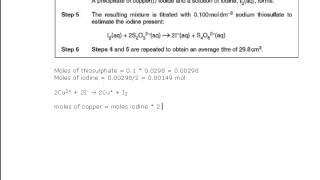
Ocr exam paper F325 from June 2011. Okay. The problem is to find out how much copper there is in a sample of brass. We have 2.8 grams of brass and we dissolve it in concentrated nitric acid. Now there will be an excess of acid there which we need to destroy, otherwise it would react with something else, potassium iodide. Further on, the best way to actually approach the calculations from these sort of questions is to go to the final results and work backwards. We're told that the resulting mixture is titrated with sodium thiosulfate to estimate the iodine present. And we're told how much of the sodium thiosulfate we used. So what we can do is we can calculate the moles of sodium thiosulfate. Now, I don't like this particular font. Let's have moles of thiosulfate is equal to the molarity times the volume. Well, the molarity is 0.1 and the volume is 0.0298. This comes to 0.00298. Now we can see from our equation here that the moles of iodine is half the moles of thiosulfate. So moles of iodine equals 0.00298 over 2, which is equal to 0.00149 moles. Now, this iodine came from a reaction in step four. So what we need now is we need the equation for the reaction in step four. What we've got is we've got copper ions in solution reacting with potassium iodide. So we need the equation for copper ions in solution reacting with potassium iodide or copper ions. Cu2. I'll format these in a minute. Plus iodide ions I minus make copper plus iodine plus I2. Now let's have a look at this. Let's format it to make it pretty. First of all, chemistry is a pretty subject. We have to have pretty equations. Alright, let's get it correct. Now then, we can see from this that the iodine. There's two iodine atoms in an iodine molecule. So we need two I. The copper changes oxidation state from 2 plus to 1 plus, so it passes one electron. Whereas the two iodines need to lose two electrons to get to iodine. So in fact, each copper is required to accept an electron. So we need as many coppers as there are iodines. And so it's a one to one reaction. Now if we know the moles of iodine, then that's formed, which we do Here we can see that the moles of copper was twice as many moles of copper needed to make these moles of iodine. So the moles of copper equals moles of iodine times two, which is equal to. And we go back to the moles of thiosulfate value moles. Okay, so we've got the moles of copper in our solution. But this was moles of copper in 25 mil of the sample. This is an easy mistake to make. If we look back here, we took a 25 centimeter cubed sample from a 250 centimeter cubed solution. So therefore, in 250 milliliters there are 0.00298 times 10 equals 0.0298 moles of copper. Okay, we've got the moles of copper, which is simple job. Now to get the mass of copper, mass is equal to moles times the atomic mass. They are which is equal to 0.0298 times 63.5. We need a calculator for this point. 0298 times 63.5. And that comes to 1.89 or 1.892 grams. 1.89 will do three significant figures. Grams. Okay, so now the percentage by copper in the brass. Will be the mass calculated of copper divided by the total mass of the brass, which we're told in the question is 2.8 grams multiplied by 100. So it's 100 times 1.89 over 2.80. And this comes to 67.6%. And that would be our final answer for the percentage of copper. Now let's just have a look at the question. Let's explain the question a little bit. I'm going to run these together. So I've got a few lines of explanation here. What's actually happening? Well, the brass is being dissolved in nitric acid. From these two equations you can see the first half equation. The second has got two electrons, the second half equation's got one. So we need to multiply all of the second half equation by two to get to there before we can combine them. So that means that copper is going to react with four nitric acid molecules. Alright? So our equation for the reaction when we add them together, take it out of here and bring it up to here. This is the first process that's going on. Copper plus four nitric acids is making copper nitrate plus nitrogen dioxide plus water. But the problem here is there's going to be excess nitric acid that has to be destroyed. If not the nitric acid itself is going to react with iodide ions because nitric acid oxidizes iodide. So we've got to get rid of the excess. Now, we get rid of the excess by reacting it with sodium carbonate solution. And so we take the nitric acid and react it with sodium carbonate. Now, this unfortunately is going to put carbonate excess carbonate ions into the system which are going to react with the copper. They're going to produce a precipitate of copper carbonate. Now, this is a. Not a problem, not a huge problem. It just means that some of the copper carbonate is taken out as a solid. Well, we have to recover that and get it back into solution. And so what we do here is we react the copper carbonate at this point, we then react with ethanoic acid to redissolve the copper ions. So we then have the copper ions in solution. And these copper ions can then, because ethanoate. Copper ethanoate is soluble. These copper ions can then go on and be analyzed by precipitation of the copper iodide and making a solution of iodine. And that is our experiment.










