Kinetics - reaction mechanism
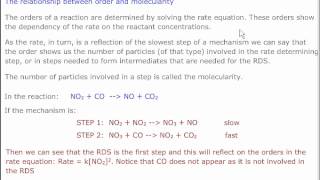
Charles Collingwood explains how to find reaction orders experimentally and use them to propose mechanisms. The rate law for NO2 and CO follows a two-step collision mechanism where the slow step determines the overall rate. Bromoalkane hydrolysis shows how a first-order rate law reveals a unimolecular rate-determining step.
Questions this video answers
2 × 10^−1 s^−1
s^−1
Chapters
Reaction kinetics is a study of how fast reactions happen. This in itself is of little importance. What we're really interested in doing is finding out the actual processes involved in a chemical reaction. First of all, to do this, we need to find out the dependency of the rate of the reaction upon the components of a reaction or the concentrations. How the concentrations of the components are affects the rate. So if we study, for example, a reaction A + B gives products, then the rate equation for this would be the rate is equal to the rate constant multiplied by the concentration of A raised to the power of X multiplied by the concentration of B raised to the power of Y. This is called the rate equation. And the first purpose of studying reaction kinetics is to find the values of X, Y and K. X is called the order of reaction with respect to A, and Y is the order of reaction with respect to B. And the total order of a chemical reaction is x plus Y. In this case, what we do is we perform a series of reactions. First of all, keeping the concentration of A constant and and vary in the concentration of B. By examining then how the rate changes when B changes, we can find out what Y is. We repeat the same process to find out the value of X. This then allows us to postulate the steps that are involved in the actual chemical reaction. And we call this the mechanism. Now, we know that particles must be involved in collisions for a chemical reaction to occur, because we need to break bonds and make bonds. And the only types of collisions that are realistically possible are one particle or two particle collisions. The one particle collision sounds silly, but what it means is the particle collides and just breaks apart itself. Three particle collisions are effectively impossible, so we ignore them. So the collision theory then, is the theory which talks about the collisions between particles. And there are three important facts that come from collision theory. A chemical reaction involves collisions between particles. A chemical reaction takes place in one or more steps, each showing the actual collisions occurring. And each step of a reaction can only involve a maximum of two particles. Now, when we measure the actual rate of reaction, we follow either a reactant or a product and see how its concentration changes with time. Effectively, though, if there are a series of steps, what we are really looking at is we are looking at the slowest step, because it is this that determines the overall rate of the chemical reaction. We call the slowest step the rate determining step. If we take an example here, nitrogen dioxide plus carbon monoxide makes nitrogen monoxide plus carbon dioxide. We can propose these two steps. Step one, Two particles of nitrogen Dioxide collide to make an intermediate nitrogen trioxide and nitrogen monoxide. This is a slow step. Then the step two, the intermediate that was formed, nitrogen trioxide, collides with the carbon monoxide particle to make the products. Well, if the first step is very slow, it will be this step that determines the overall rate of the reaction. So we wouldn't expect to see any change in carbon monoxide concentration affecting the overall rate. Once we have a series of steps which seems to fit a chemical reaction, we call this the mechanism. Now this is where the importance of the order comes in. The order of a chemical reaction shows us how the overall rate depends upon that particular species. So if we obtain orders by solving the rate equation, we can then say that the orders effectively tell us how many of those particles are involved in the rate determining step or how are needed to form particles intermediates that are going to be used in the rate determining step. Now, if we look at the example once again that we've just used, step one only involved two particles of nitrogen dioxide and it was the slow step. And that means then that step two is too fast to measure. So we will find that the rate equation will only involve NO two particles. And because two of them are needed for collision, we'll find that doubling the concentration of nitrogen dioxide will have the effect of quadrupling the rate. In other words, the number of particles that appear in the rate determining step here will be the order with respect to no 2. And if we look down here, here is the rate equation. Rate equals k no 2 square. Once again, notice that carbon monoxide doesn't appear because it's not involved in the rate determining step. So when we propose a mechanism, we must take two ideas. We must look at the orders of the reaction and we must try to make sure that those particles are then found in the rate determining step or are needed to make an intermediate that appear in the rate determining step. The other thing that must be fulfilled is that the sum of all the steps must give the stoichiometric equation for the reaction. So once again we look at the same two steps. Here, two step reaction 2 no 2 goes to no 3 plus no. No 3 plus co gives no 2 plus co 2. We add these two steps together. Well, the no 3 will be on the right, no 3 on the left. They'll cancel. One of the no 2s on the right will cancel out with one of the no 2s on the left, and we'll end up with the stoichiometric equation. So these two steps, this two step mechanism fulfils both the rate equation and the rule that the sum of the steps must equal the stoichiometry. So to summarize, chemical reactions such as a B gives products. We perform a series of experiments in order to find out the orders in the rate equation. X and Y. Once we've got the orders X and Y, these give information about the rate determining step, Then we use some logical deduction and we propose a mechanism. It's important to remember that the proposed mechanism doesn't have to be correct. In many cases it would be very difficult to find out if it is correct. It just must fulfill the basic requirements. Lets look at an example. This is a bromoalkane and it can be hydrolyzed by aqueous sodium hydroxide solution. Oh. Now if we choose, if we just represent the bromoalkane as X, we've got this kinetic data. Now what does the kinetic data tell us? Well, notice when X is doubled in experiments 2 and 3 and oh is kept constant. Well, any change in X is also reflected in the initial rate data. Here X is doubled and the initial rate is doubled. That means the dependency is a direct relationship. The order with respect to x is 1. However, if we look at experiments 1 and 2, in these two experiments x is constant and here oh has doubled. But look, the initial rate doesn't change. This means there is no dependence of the rate on oh, so it doesn't appear in the rate equation. So to deduce the rate expression, then we see that the rate is equal to K x to the 1, oh minus to the 0, we know anything to the power of 0 is 1. So we can simplify this to rate equals kx to the 1, or simply rate equals K times concentration of X to determine the value of the rate constant. Well, if we have one value for rate, one value for X and we know that OH doesn't appear, well we could see that we should be able to work out K very, very simply. K will be equal to the rate 4 times 10 to the minus 3 divided by 2 times 10 to the minus 2, which is equal to 2 times 10 to the minus 1. The units of the rate equation, however, sorry, the rate constant. The units of the rate constant. Well, the initial rate units here are in moles per liter per second. So what we do is we write out the rate equation. Rate equals K X to the power of one and then we substitute in the units for each of the components we know, rearranging to get K. So if we have a look here, rate is equal K times a concentration of X. Rearrange this K equals the rate divided by the concentration of X. Substitute in the units K is moles per liter per second divided by moles per liter. So it's seconds to the minus one. Now finally we want to propose a mechanism. Alright. Well, we go back to the rate expression. Rate expression is rate equals K and it only depends on X. And there's only one particle of X in this rate determining step. Now the only way we can have one particle is if it breaks apart. So our hypothesis here is that bromoalkane breaks apart to give two particles. One of these two particles is an intermediate then and the intermediate then picks up an oh to make an alcohol. Which of the two steps is slow? Which of the two steps is fast? Well, if the second step were fast, then we would see OH and the bromoalkane both appearing in the rate equation. But the rate equation, the rate expression, remember, was simply the bromoalkane appears. So there's no oh. So the slowest step must be the very first step.










