Kinetics - the rate equation
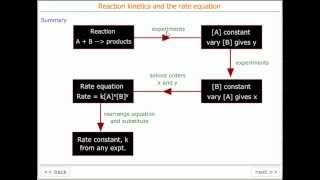
Reaction rate is the change in concentration over time, measured by tracking gas volume, mass, or color. The rate equation shows how rate depends on reactant concentrations: rate = k[A]^x[B]^y, where x and y are the orders you find by varying one reactant while holding others constant.
Chapters
Reaction KINETICS in the rate equation, the rate of a chemical reaction is defined as the rate of change of concentration of a reactant or product. This could be given as an equation. Rate equals change in concentration of A divided by change in time. There are some practical problems, though, that we need to overcome. It's not easy usually to measure directly the concentration of a particular component, particularly as it's changing. So what we do is we choose something else that could be related to the concentration. Also, the rate changes during the course of a chemical reaction. So to overcome this, we try to measure the rate at the initial phase, the start of the chemical reaction, which is when we know the concentrations. As I said, instead of trying to measure the concentration directly, we can measure things such as gas volume, mass loss, if there's a gas produced, conductivity, colour, absorption, pH, etc. There are many things that we can look at depending on the specific reaction. And as we know the concentration of reactants at the beginning, we measure the initial rate. That's the rate at time equals zero. We can do this from graphical methods using the tangent to the curve of concentration against time. We take this for time equals naught. The tangent measure the gradient, which is the difference in X, difference in Y divided by difference in X, and that then gives us the value for the rate of the reaction at time equals zero, the initial rate. If we choose reaction conditions that give a relatively steady rate over the initial phase, then the gradient will be relatively straight. The gradient has to be straight. The curve will be relatively straight over the initial phase and that will give us a more secure gradient. We could also choose to measure the average rate over a predetermined phase of the reaction. This is how clock reactions work. So we're going to derive a rate equation. This rate equation will tell us how the rate depends upon the concentration of the reactants. There are three possibilities. One, that is not affected at all by the concentration, two, that it's directly proportional, or three, that there's some other relationship. We can cover all these three possibilities using the rate equation. Rate equals K, the rate constant multiplied by concentration of A raised to the power of X multiplied by concentration of B raised to the power of Y, where the reaction is A plus B gives products. The values X and Y are called the orders with respect to A and B. Now, our three possibilities. Well, when X is zero, there's no relationship between the concentration of A and the rate because a to the 0 is 1. When x is 1, the concentration of A is directly proportional because anything to the power of one is itself. So concentration of A to the one is just the concentration of A. And any other value of X means there's a more complex relationship. In reality, we usually only find, certainly at this level, that x could be 2 as another possibility. So how do we solve the rate equation? Well, we simply choose. For a reaction, A plus B gives products. We know that the rate equation is, and we'll go back to it. Rate equals K a circumflex X B to the Y. If we keep a constant, then a circumflex X is then constant and K is like a super constant. So the rate is proportional to or equal to K multiplied by B circumflex y. If we then do experiments varying B, we can see how the rate varies. And then from that we'll be able to get Y over the page. As an example here, in this reaction, you'll see that in experiment one and two, the concentration of A is kept constant. That means anything that happens to B could cause a change in the initial rate. But if we look here, we'll see that when B is doubled from experiments one to two, nothing happens to the initial rate. The initial rate stays the same. So B doesn't affect the rate at all. And that means the order with respect to B is zero. Now look at experiments 2 and 3. In these, B is constant, whereas A gets doubled. When A gets doubled, the initial rate doubles. So that means that as B is constant, we can ignore B. So the only thing that affects rate is A. And as A is doubled, the rate is doubled. So the order with respect to A is one. So what do we do with the rate constant? Well, once we have all of the orders of reaction, we just substitute these into the rate equation. We rearrange the rate equation so that K is on its own and equal to the rate divided by A to the XP to the Y. And then we simply take any of our experimental runs, experiment one, two or three, and substitute values. In this particular case, we've got we know that A is 1 with respect to A is 1. The order with respect to B is 0. And so if we substitute in experiment one using our equation, well, it becomes K equals 4 times 10 to the minus 3. Remember, we can discount B because B to the y is 1, so its rate divided by the concentration of A. So K is equal to 2 times 10 to the minus 1 seconds to the minus 1. So in summary, our process, we have a reaction, for example, A, B products. We perform experiments, we keep the concentration of A constant. We Vary B, and this allows us to find Y. We then perform more experiments keeping B constant. We vary A. This allows us to find X. So now we've got the orders X and Y. We can now substitute these in the rate equation. And then if we wish to find the rate constant, we rearrange the equation and substitute. And we got the rate constant from any experiment. Let's look at another example. In the reaction between nitrogen monoxide and hydrogen forming nitrogen and water at elevated temperatures. We've got the following data here. If we examine it again. Let's look at it. We'll see that experiments two and three. We keep no concentration constant while the hydrogen concentration doubles. And here, look. Notice the initial rate also doubles. Well, that tells me that hydrogen has an order of 1. Experiments 1 and 2. The hydrogen is constant, whereas the nitrogen monoxide doubles and the rate increases by a factor of four. So for doubling the concentration of nitrogen monoxide, the rate goes up by a factor of four. This means the order with respect to nitrogen monoxide must be 2. So let's get the rate expression for the reaction from this. You'll see rate equals kno squared h2 to the 1. To determine the value of the rate constant. Remember, what we have to do now is we have to substitute the value values in. You can choose any particular reaction. I've chosen experiment 3. Choosing experiment 3 because the values of 10 and 10 are very convenient. The rate is kno 2 squared times h2. So rearranging k equals rate over no 2 squared h2. Then we just substitute the numbers in and we get rate K is 250. We need to know the units of the rate constant. It's a similar process, only this time instead of substituting the numbers, we substitute the dimensions or the units. The rate is kno 2 squared h2 so that k is rate over no 2 squared. So no squared h2. Substituting in the units moles per liter per second over mole cubed DM -9. Cancel down and that gives K is DM 6 mole of -2 seconds to the -1.










