Transcript of a short instructional video explaining Lewis structures and how electron pairs determine molecular shape. Covers counting valence electrons from the periodic table, drawing Lewis structures, and applying VSEPR ideas to methane (CH4) and water (H2O), including numerical bond angles and the effect of lone-pair repulsion.
Questions this video answers
6
5
4
1
109° 28' (about 109.5°)
Chapters
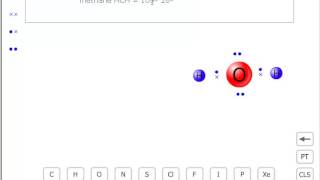
Lewis structures and the shapes of molecules and ions for that matter. The Lewis structure shows the arrangement of electrons around an atom or the atoms within a molecule or ion. The number of electrons that each atom provides can be seen from the periodic table. Oxygen, for example, has got six outer electrons. Nitrogen, 5, carbon, 4H, hydrogen, one outer electron. So whenever we have atoms bonded together, then the number of outer electrons that there will be in total will be the sum of the outer electrons of each of the component atoms. Take for example carbon. Carbon is in group four. It has four electrons. These four electrons can be represented as Lexus, like this. And the carbon atom itself isn't stable. It doesn't have a full outer shell. When it bonds, it bonds to as many atoms as it needs to make a full outer shell of electrons. You can see that hydrogen, which has got one electron in the outer shell, could bond to carbon here using one electron from the hydrogen, one electron from the carbon and that would make a bond with a shared pair of electrons. Clearly this could happen on all four sides. We could have four hydrogen atoms, each providing its own electron to make. A total of eight electrons around the central atom. And this would give us our final Lewis structure around the molecule. The question is, what shape is this? Well, the Lewis structure gives us the number of electron pairs or regions of negative charge. These will repel as far apart as possible. But we mustn't forget that it's a three dimensional shape. And a three dimensional shape will have a tetrahedral orientation. This will allow the atoms to, or better said, the electron pairs to be as far apart as possible. Difficulty picking up this electron pair as far apart as possible. I can't get hold of this hydrogen. There it goes. Let's bring this back in. And you see here that the bond angle, the expected bond angle in methane we put up here. Methane. Let's run away. There we go. Put that back there. Methane has got a HCH bond angle equal to a tetrahedral perfect tetrahedral bond angle which is 109 degrees. 109 degrees, 28 minutes, about 109.5 degrees. Alright, so if we then look at this with a different molecule. Let's clear the screen. Let's imagine we have say a water molecule. Well, oxygen from our periodic table. Remember, oxygen has got six electrons in the outer shell and water of course is H2O. It's going to bond to two hydrogens once again, each hydrogen. And let's move it right over to the right hand side this time to give us more room each Hydrogen is going to be bonded by a shared pair of electrons. If we do our accountancy well, the six electrons from the oxygens add to the two electrons from the hydrogens. That makes eight electrons altogether. Well, we've used four in bonding, which means that there's still two lone pairs on the oxygen. Now, once again, we should easily be able to see here there's 1, 2, 3, 4 regions of negative charge. So once again, these regions of negative charge, they're going to arrange themselves in the form of a tetrahedron. But this time, only two of the hydrogens are going to be in the shape. So oxygen occupies the central atom position and 1, 2 hydrogens. And of course, we've got two lone pairs. Now, what would happen under this circum in this situation, we would expect the bond angle here to be 109, 28, the same as methane. But in fact, what happens is that the water jumped again. The water bond angle is going to be squeezed together by the effect of two lone pairs, which repel the bonding pairs more than the bonding pairs repel each other. And so the result of that is that this HOH bond angle, HOH bond angle is equal to 104 degrees, 104.5 degrees. The rough rule of thumb is that we lose about 2.5 degrees per bonding pair, lone pair, bonding pair repulsion. So even though the, when it's drawn out in two dimensions, the water molecule looks to be linear, when we consider it in three dimensions, we can see quite clearly that the molecule is going to be. The molecule is going to be tetrahedral electronically and the molecular shape is bent.