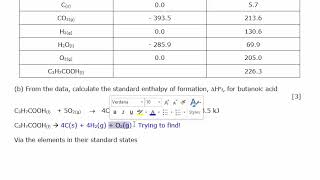
This content was created by Charles Collingwood. This content was uploaded by Charles Collingwood. This is a YouTube video titled "M00H2 Q2" created on April 26, 2018, featuring Charles Collingwood explaining the process of calculating the enthalpy of formation for butanoic acid from its elements, using a balanced chemical equation and data from a table.
Chapters
Ib question on butanoic acid from about the year 2000. Unknown. Write a balanced equation for the formation of butanoic acid from its elements. We take butanoic acid, put it down here, and then look at the elements it contains. It contains four carbon atoms, so that's 4C solid. It contains seven, eight hydrogen atoms. That's 4H2 gas. And it contains two oxygen atoms, O2 gas. And that constitutes the equation that represents the enthalpy of formation of butanoic acid. Easy peasy. Let's record it in blue. There we go. Okay, now then, the data table shows various different enthalpies of formation. Carbon, carbon dioxide, hydrogen. See, notice the enthalpy of formation of carbon, hydrogen and oxygen are all zero because they're already elements. So you can't. The energy required to form an element from an element is clearly going to be zero. So we have to calculate the standard enthalpy of formation for butanoic acid. Now we're given up here the combustion equation. And we know the enthalpy change for this combustion equation. So I'm going to write this one down. Is -2183. So let's get a bit of space here. Put this down here. Delta H is -2183.5 kilojoules. Okay, now if we split these up into the elements in their standard states to go from the elements in standard states from this. So what we're talking about is to be talking about this process going to the. Its constituent elements is what we're trying to find. We haven't got a value for it, but we have got an equation for it. There's the equation for it. It's that one backwards. Let's put the equation down. Doesn't help us at all, but it looks pretty all right. This is our unknown. We're trying to find this. Trying to find. Now the enthalpy of. If we go via the elements in their standard states. This is the negative of the enthalpy of formation of butanoic acid. So this first, first phase here is negative delta H. I'm going to put this one down here. Negative delta H. F. I haven't got my delta sign anywhere. I just get a delta sign handy. Negative delta. It's a bit small. No, Negative delta HF Right now to make oxygen. Oxygen into its elements in standard state is no effort whatsoever. It is. So if you like, we could just add another five oxygens here. We could add six oxygens if you like, because now that's the five oxygens here. Going down to join this equation, right? So now we've got from the reactants to the elements in their standard states. And now what we need to do is take the elements in their standard states, this part, and make them into the products. And there's the products over here. And this is going to be four times the enthalpy of formation of carbon dioxide and four times the enthalpy of formation of water. Now we've got both of these pieces of data in the, in the table above. There's the enthalpy of formation of carbon dioxide. So we're here four, four times minus 393.5 plus four times whatever the enthalpy of formation of water is, which again we get from the table above, enthalpy of formation of water -285.9. And we just find out what that equals. Well, that equals. Leave My calculator here. 393.5 times 4, 1 5. Negative 1574. Plus minus four times two eight five, 11 43.6. So we add these two together, We get to negative 2717.6. Now, the first step that we didn't know this is what we're trying to find out, is the enthalpy of formation of this. Enthalpy of formation of this. So this was the unknown step in our.