M15H2TZ1Q1
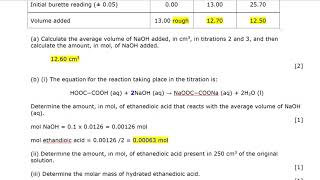
Charles Collingwood works through a titration problem to find how many water molecules are bound to an ethanoic acid crystal. Using 12.60 cm3 of 0.10 mol/dm3 NaOH and 0.795 g of the hydrated salt, he calculates that x equals 2.
Questions this video answers
0.795 g
0.10 mol dm^-3
12.60 cm^3
0.00126 mol
0.00063 mol
Chapters
All right. Okay. This is the question that Nara has asked me to have a look at. So let's have a little look at it. First of all, we're told that ethanoic acid is a diprotic acid. Right? Let's just, let's just unpack. Diprotic. Diprotic means it's got two. Diprotic means it's got two hydrogen atom or ions per acid molecule. All right, two hydrogen acids per acid molecule. So that means. And there you can see them. The student has determining the volume of hydrated ethanoic acid. And there are the two acidic hydrogens. There's one here, I want to just paint them red to show you. These are the two hydrogen ions that are lost when the acid reacts with the solution of sodium hydroxide. So let's just put this down to show the actual reaction. Now these are water molecules with crystallization. Once you dissolve the acid, these just intermingle with the water. But of course, before you weigh it out or when you weigh it out, you can't help but weigh the XH2O out as well. So. So the first part of the experiment, the first part of the question involves determining this part of the acid. How many of these are going to react with two naohs? I didn't really want that to be red as well. Let me just take that back to automatic color. They're going to react with 2 sodium hydroxides to give the, to give the products. Products. Well, it doesn't really matter. It's a product. It's just the Ethan dioate ion replaced by sodium ions. So it's like there sodium, there sodium. And there's going to be two water molecules, two H2O. This is our acid base reaction. This is the basis behind this kind of experiment. Let's put that in the middle just to see. We probably need to do this. Okay, so the actual experimental now 0.975 grams of ethanic dioc acid. Now remember this, we're weighing out all of this. So let's put that copy, we're going to put that in brackets here just so you can remember. That's what we're weighing out. It was dissolved into still water and made up to a total of 250 centimeter cubed in a volumetric flask. Alright? Now we don't know how much of this mass is actually the ethandioic acid and not the water. And that's the task of the titration to find out how much of the ethandioic acid is actually present. So there's a titration carried out. We use 25cm cubed of this solution, an unknown solution, remember, put into a flask and titrated against aqueous sodium hydroxide solution using phenolphthalium as the indicator. Now, the sodium hydroxide solution is here, look. That's the concentration of the sodium hydroxide solution. So I'm going to put that in brackets there just to remind us, just to help us out. Right, so let's have a look at the titration. Now, titration one, you see it used? No. There we are. The difference between this and this will be the volume added. So the volume added there is 13.00. In the second titration, the difference between these two, the 25.7 and 13, well you can see is 12.7, 12.70. And in the third one, if you have a look, the difference between the two. 38.20 minus 25.70. Probably going to use a calculator for that. One difference is 5. That's 0.50 and it must be 12. It's 12.50. Now, this first one is well out of line with the other two. The other two here, actually. Have I calculated that right? 25, 27 minus. Yes, 12.7. That's 12.5. The average of these two. These are the two most concordant results. So our average type, average volume that should be used for this calculation will be the average of 12.7 and 12.5, which is. Which must be 12.6. So I'm going to put that down here. 12.60 centimeters cubed. All right, let's make it nice and blue so we can see the answers as we go. I like to be clear what the answer is. There's 12.60cm cubed. I've done the calc. Have I written these down right things. 38.2 minus 25.7 is 12.5. 25.7 minus 13 is 12.7. Yeah, that's right. I've done that. Right, this is the rough titration. The first one we do will always be a bigger number because it's a rough titration. So this is our rough titration. All right, just highlight that. Just that we know that this is rough. Okay, now then, now then, what do we do? The equation for the reaction. Now they've given you the equation for the reaction. That was very nice of them. I wouldn't have given you it. I'd have let you work that out for yourself. Determine the amount in moles of ethandioic acid that reacts with the average volume of sodium hydroxide. So first of all, we want the moles of sodium hydroxide, moles of NaOH, and we get the moles of the Noh from the titer. It's the molarity times the volume, the concentration times the volume. Remember, the concentration is. Is 0.1. So it's 0.1 times the volume in liters, which is naught 0.0126. And that comes to 0.00126 mole. All right, so this is the amount in moles of ethanoethandi. Oh, no, no, wait a minute. This isn't. This is the amount in moles of sodium hydroxide. But let's look at the equivalence here. You'll see there are two moles of, of sodium hydroxide for every one mole of Ethan dioic acid. So the moles of Ethan dioic acid is actually half that. Moles of ethandioic acid equals 0.00126 over 2. I've missed a naught out. I can see that. Which comes to 0.063 moles. This is the, this is the moles of Ethan dioic acid. Right. This is our answer here. Let's highlight it in blue. A bit of. Bit of color. These are our answers. We go through bit of color. Right. So, okay, now this was in a 25. If you look at the work here, it says 25 centimeter cubed of ethanol. Dic acid was pipetted into a flask. So we, we did the titration with 25cm cubed. Now this part of the question says determine the amount in moles in 250. Well, the relationship between 25 and 250 is 10. So the moles in 250 centimeter cubed equals 10 times 0.00063. Equals 0.0063 moles. Now we know the moles of Ethan dioc acid. All right, let me highlight it. There's the moles of ethandioic acid. Okay, so we've got the moles of ethandioic acid. Well, now we can work out the molar mass of the hydrated ethandioic acid. How? Well, we know the number of moles and we know the actual mass that was weighed out and that was the. Of the whole thing. Remember 0.795. So the molar mass. Molar mass equals the. Well, if you remember that moles is mass over erosive mass or molar mass. So molar mass must Be equal to mass over moles, which is zero point. What did I say it was? 795 over the number of moles? 0.0063. Now I can't work that in my head, but I have got a calculator handy here. So let's have a look. Put it on. Where's the calculator? Come on. There's on 795 divided by 0.0063 and that comes to 126.19. 126.19. All right, so if the molar mass is 126.19 of. Remember, this is the molar mass of the whole thing. Of all of that. Where are we molar mass of. I'm going to put it in there. Of that. Okay, is now how do we determine the value of X? Well, it's not too hard now because if we know the moles of all of that will also equal the moles of that and X moles of water. So if we know the molar mass of the whole thing, we simply need to subtract the molar mass of this part to get the mass, the molar mass of XH2O, so to speak. So the molar, what does it say? The relative. Let's see. Relative. Relative mass of this part. Will be equal to, well, the sum of the parts, won't it? The relative mass is the sum of the parts. Well, there's four oxygens, two carbons and two hydrogens. So that's four. 16 of 64. Let's do it piecemeal. 64 plus 24. The two carbons plus two for the hydrogens equals. What's that? 64, 88, 90. Therefore. Therefore the mass or the relative mass relative mass of water equals. It's not water water. It's x water. Remember, of x water will be equal to the calculated 126.19126 minus 90, which comes to 36. Now the relative mass of H2O. Equals 18. Therefore there are two water molecules. Therefore x equals 2. And if you need to explain it fully, because 2 times 18 equals 36 which is the missing molar mass bits, so to speak. Let's make it pretty again and let's just put highlight that, give it that. And the next part is not your interest. The next part. Because that is not what you asked me. Therefore this is the entire question. Let me just put that in blue. If you need to review it at any time, you can just watch the video. Okay, bye.










