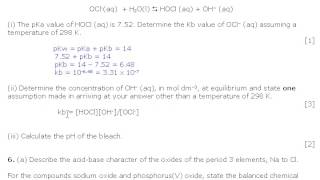
Charles Collingwood works through an acid-base equilibrium problem for a 0.705 M NaOCl solution. Starting from pKa of HOCl (7.52), he derives pKb for hypochlorite, calculates KB as 3.31×10^-7, then finds [OH-] at equilibrium and determines the pH is approximately 10.7.
Chapters
Ivypast paper November 2011 high level paper 2 hypochlorous acid is an example of a weak acid state. The expression for the ionic product constant of water. So the first question has nothing to do with hypochlorous acid. It's just asking us for the value for K kW. KW, the ionic product constant is equal to the hydrogen ion concentration times the OH ion concentration. That's our expression. Then we're told that a household bleach contains sodium hypochlorite at a concentration of 0.705. And the hypochlorite ion is a weak base there. The hypochlorite ion is acting as a weak base. It's picking up a proton from water and it's making the conjugate acid, which is the hypochlorous acid. And at the same time, oh, we're told the PKA value of hypochlorous acid is 7.52. So we're asked to determine the KB value of its conjugate base. Well, there's several ways we can do this, but we need the expression, the KW expression. If we take the fact that kw is 1 times 10 to the minus 14, this gives us a value for PKW equals PKA plus PKB. It's the acid dissociation constant plus the dissociation constant of the conjugate base. We know that pkw is equal to 14. So for our calculation here, if the conjugate acid, if the conjugate Acid Hocl is 7.54, we could say that for that PKA 7.52 sorry, 7.52 plus PKB equals 14. And so you can see pretty pretty much there, that PKB equals 14 -7.52 equals 6.48. I don't know what's happened to the formatting there. Let's just give that the color. Now to determine. I'm sorry, I'm not quite there yet. We're asked to work out the KB value, not the PKB. Well, KB, the relationship between PKB and KB. PKB is a negative log. So KB is equal to 10 to the power of minus 6.48. This is effectively what we're looking at is the anti log here. And this comes to working the calculator. 3.31 times 10 to the minus 7, Our value for kb. Now we're asked to determine the concentration of OH in multiple L at equilibrium and state. One assumption made in arriving at your answer, other than the temperature of 298. Alright, so we're looking at this equation. We've now got the PKB value for this equation. So the KB value. So we can say that KB equals and we can see the two species, the concentration of HOCL and the concentration of OH and this divided by concentration of ocl ocl. What's happened to that? We've missed the capital OCL minus. Now we've ignored the water of course in this equilibrium because water is in vast excess and isn't used in the KB expression. Now if OCL is a very weak base, it means that effectively very little of the equilibrium lies to the right hand side. And so we can take the value for the hypochlorite ion as being the initial value. Now we're told it the initial value is here 0.0705. So this is our assumption. We're going to rearrange our equation to get so KB down here. KB multiplied by the OCL iron concentration which is going to be the initial 0.705 is equal to Hocl multiplied by oh. Now as these are both the same number of moles, obviously in our equation, one mole of that changes to one mole of that plus one mole of that. X moles of the OCL changes to X and X of that. So the hypochlorous acid and the OH ion concentration must be the same. So this gives us the OH minus ion concentration squared as they're both the same. It's the same as writing OH concentration squared. Now to get an expression for kb, We know the value of KB is 3.31 times 10 to the minus 7. Let's put that in here. 3.31 times 10 to the -7. And we're going to multiply this by. 0.705. And this is going to be equal to H plus squared. So the square root of all of this. Is going to equal H plus squared. Sorry. OH minus squared. OH, minus not squared, the OH minus ion concentration. So now we need our calculator. To 3.31 times 10 to the minus 7. 3.31 exponential minus 7 multiplied by 0.705 that comes to 2.33 times 10 to the minus 7. Is it 1, 2, 3, 4, 5? Yes. Now we take the square root of that and that comes to 0.000483. Better expressed as 4.83 times 10. To the -4. Moles per liter of course. Now finally we have to calculate the ph of the bleach well from this OH minus ion concentration we can get. The POH is equal to the negative log log of the OH minus ion concentration. So it's a negative log of. So we take our negative. We take our log. That gives us minus 3.316. So the PAH is 3.316. And we know that poh +ph equals 14. Hence ph equals 14 minus 3.316, Which comes to 10.7, 10.68, 10.7, And that's the end of this question.