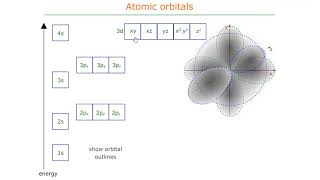
Charles Collingwood explains atomic orbitals as regions where you'll find an electron 99% of the time. They come from solving the Schrödinger equation and have distinct shapes: s, p, and d orbitals hold different numbers of electrons in a specific filling order, with the 4s orbital filling before 3d.
Chapters
The atomic orbitals are the regions of space around an atom in which there's a 0.99 probability of finding an electron with a certain amount of energy. The actual shapes of the orbitals emerge from solutions of the Schrodinger's equation for the hydrogen atom. And the same shapes are applied to all of the other atoms. The rules for electrons going into these orbitals are fairly simple. Each orbital can fit and house a maximum of two electrons, each with opposite spin. The orbitals have, as I said, defined shapes. If we have a Look at the 1s orbital around an axis, we'll see that the 1s orbital occupies a spherical orbital region of space around the X, Y and Z axes. So the outline would show the region of space in which There is a 0.99 probability of finding a specific electron. The second energy level has got 4 orbitals. It's got 1s spherical orbital, but it has 3p orbitals each of the P orbitals. I'm going to close the S orbitals off so we can see the P orbitals on their own. There are three P orbitals aligned along the three axes of a three dimensional coordinate grid. The 2px orbital lies along the x axis, the 2py lies along the y axis, and the 2pz lies along the Z axis. They're shaped a little bit like double headed balloons. We turn these out. In the third energy level, we get exactly the same pattern repeated. We have the 3s orbital, which is spherical, and we have 3p orbitals aligned along the axes. So that means in each energy level we can have a certain number of electrons. In the first energy level, we can have two electrons. In the second energy level, we can have a maximum of eight electrons. And the third energy level continues with D orbitals. Now the D orbitals are more complicated in shape and there are five of them. But before the D orbitals fill, we actually fill the s orbital, the 4s orbital, which is larger than the 3s orbital. In fact, if I get rid of the other pictures here, the other oops. You'll see that the 4S orbital occupies a larger volume sphere. The 3D orbitals we have a look at 3. There are five 3D orbitals. There are three that are identical but occupy different regions along the axes. There's a DXY that occupies. It's a four headed mechanical kind of foreheaded balloon. It occupies the regions between the X and the y axes. The 3DZ is the same. Sorry. The 3D XZ occupies the regions between the X and the z axes and the 3D yz between the y and the z axes. So these three orbitals are said to be degenerate because they they have exactly the same orientation and shape. In fact, all of the orbitals are degenerate with the same energy until they have electrons in them. The 3D x squared minus y squared occupies regions of space along the x and y axis. And finally, the 3D z squared is an orbital that lies only along the z axis, with a peculiar kind of node in the middle. So this picture of the energy, the orbitals arranged in terms of energy, is sometimes called the electron in a box model. We could go on and put the electrons as pairs in each one S2 S2P x2P y2PZ and then fill up XYZ. So we fill up the orbitals from the lowest energy out towards the higher energy orbitals.