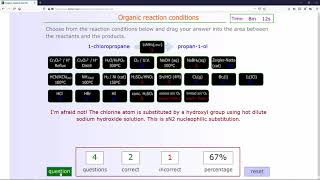
This content was created by Charles Collingwood. This content was uploaded by Charles Collingwood. This is a YouTube video titled "Organic reagents test" created on April 5, 2020. It features Charles Collingwood conducting a walkthrough of an organic chemistry reagents and conditions test from the ibchem.com site, demonstrating how to answer questions and providing explanations for correct and incorrect answers.
Chapters
Okay, charcoal here. We're going to do a run through of the organic chemistry reagents and conditions test you see on the screen. We've called up the test from ibchem.com site and we just fill in our details so there's no further ado. Let me fill in the name. Well, let's not be too formal. Let's just leave it at charcoal. And I'm going to fill in my email address. Let's just say we're going to do 10 questions. OK, so press enter. This takes us into the question area. You see the instructions here. Click on the question button to start. Okay, question button is down here on the left hand side. There's a reset button over here and there's an analysis area. These tabs, these black tabs we see here, each of them has a reagent and conditions for an organic transformation. So pressing on the question, see up here the question appears methanol transformed to methanol. So we need to find from one of the tabs which particular reagent and conditions is appropriate for this transformation. What we can see it's, we should say it's an oxidation from an alcohol to an aldehyde. And the best conditions for this would be to distill using sodium dichromate in acidic solution. So we'll drag the tab into its position here and we get great bit of mark. It says we're correct. Methanol must be distilled with acidified potassium dichromate 6 and the more volatile methanol is distilled off as it's formed. Okay, great. So straight onto the next question. Let's have a look. What we have is 1,2 iodoethane to Ethan 1,2 diol. So we're replacing two iodines with two OH groups, two hydroxyl groups. So sodium hydroxide in 100 degrees C in aqueous solution. That does the trick. Well, let's see what happens if we get question wrong. Okay. One chloropropane to Propy1ol. Let's imagine we have to do that with lithium aluminium hydride. We don't of course, but drag that into position and it tells us not. But it also tells us what we should have done. The chlorine atom substituted by a hydroxyl group using hot dilute sodium hydroxide solution. It's an SN2 nucleophilic substitution. In this case we'll ask the next question. Phenyl ethene to 1, 2 dibromo phenyl ethane so we are adding across the double bond two bromine atoms. So we need to find bromine, bromine liquid. We put this into here and this gives us an answer. Okay, I'm going to shoot through with a few wrong answers so we see what we get. Now, each time we get a wrong answer, we're gonna. It'll tell us off and give us. Give us the correct answer. It's a man. One, two. Dibromoethane. Ethan. One, two. Diol. Excess air? No, of course not. And let's go to another one. We'll drop it up with excess air, see what happens here. No, afraid not. And again, it tells us what we have to do. Carboxylic acid to primary alcohol in there? No. And then the last question, because we're doing 10 questions, let's get this one right, shall we? PropY2 or Propanol. It's a reflux. It's sodium dichromate in sulfuric acid reflux to give this. Oh, no, it's not. It's a secondary alcohol. It's distilled with acidified potassium dichromate. 6. It's a redox reaction. Okay, so we get the end of the test. We've scored 30%. We press the C summary button. Now, this will give us our analysis. We see down here we've got the list of questions that we got wrong for us to work on. And just in case we can't remember, when we press the send and close, this will send the answers to whichever email address we've entered in the form, and we will receive them with a list of what we got wrong. If we wish to try the test again, it's simply a question of pressing the reset button. And then we're back in with a question. Notice the time continues. It starts again from one minute per question. Okay, that's about the size of it.