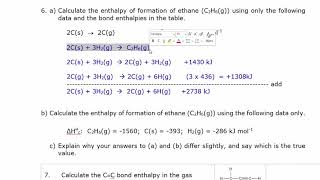
A worked example (YouTube tutorial) by Charles Collingwood calculating the enthalpy of formation of ethane (C2H6) from elemental standard states using bond enthalpies. The instructor converts elements to atoms (sublimation of carbon, dissociation of H2), sums bond-breaking energies, subtracts bond-formation energies for C–C and C–H bonds, and obtains an overall ΔHf ≈ −82 kJ (exothermic).
Questions this video answers
Approximately −82 kJ (per mole, computed by the instructor).
Chapters
Okay, there's been a few questions about question number six or a few problems with question number six. Let's have a look. What it says. Calculate the enthalpy of formation of ethane using only the following data and the bond enthalpies in the table. Alright, so the first thing we have to do is write out the formula for the enthalpy of formation of ethane. Well, ethane is C2H6. Let's work backwards, shall we? We may as well. It's there for us. I'm going to copy it down here. Just tab over there somewhere. This is tabbing in a very strange way. Maybe I shouldn't tab. Let's just run it over there. Did the same thing again. There's all sorts of issues going on here, aren't there? We just run it across with this. So there's C2H6 is what we have to make. How do we make it? Well, going to make it from its elements in their standard state. So over here we have to have two carbon and what's the, what's carbon in its standard state? It's a solid. And we're going to add this to 3H2. What's this in its standard state? It's a gas. It's hydrogen gas. All right, so this is our equation. This is the equation that we want to, we want to generate, if you like. Let's move this back a little bit. I'm sorry, I'm a bit of a, bit of a maniacal format. I like to have things look. Right. All right, this is our equation. Let's put it in blue so that we can see what we're aiming for. Nice blue. Shall we? More colors. That's the one I like to use. That one there. Okay, there's a nice blue. All right, so now we want to use bond enthalpies, but we're not allowed to use bond enthalpies unless the substances are atomic. Now neither of these two substances are atomic. So we have to take these two and we have to make them first of all into atomic substances. How do we do that? Well, carbon is in the solid form and we know that to turn carbon solid into carbon gas will require 715 kilojoules. To take two carbon solids into two carbon gas will be two times this, won't it? Two times. That makes sense, doesn't it? All right, so if we go, if we just start the process by saying this goes to this carbon gas. Well, already we've used two times 715, which is 1, 4, 301430. Whoops. I put the positive sign at the wrong end. Kilojoules of energy. Agreed. Are we all happy with that? We can all see that. But we also want the hydrogens in the form of atoms as well. So we take this step from there. And we transform this into almost the same thing, except we're going to change the hydrogen molecules into hydrogen atoms. This is six hydrogen atoms. Six H. So what have we done? Well, we've broken the hydrogen bonds here, haven't we? Three hydrogen bonds. So this step alone, let's go up to the table. A hydrogen hydrogen bond is worth four, three, six. And we've broken three of them. So this is three times four, three six. For this step, three times four, three six using the mighty calculator brain, is that's three 36s or 108, if I'm not much mistaken, they are 108 and three fours are 12. So that's 1308 kilojoules. Okay, so to go from here to here, we'll require the sum of these two. All right, so let's do a. Let's do a little line to show that we're going to add these up now and we'll just put add. Right. So now we can actually write from here copy to. To here. Will be that plus. That will be plus 273 8. 2738 kilojoules. Now have we got the equation we want? No. In terms of bond enthalpies, we have to break these into their bonds and that requires this energy. Then we have to make the bonds in this side. Alright, now C2H6 contains. So it contains. Let's put this down. C2h6 contains 1c c bond. And 6ch bonds. Now when we make these bonds, they will release energy. So the energy released here, energy released equals negative. Well, 1cc we go up here. 1cc is 3, 4 8. 348 plus 6 times 41 2. I believe it is 412. And we work this sum out. I'm going to cheat. I'm going to use a calculator. Right? So first of all, I do 6 times 412 equals plus 348 equals 25102510 kilojoules. Negative. Of course this is negative. So to get from here. To here, Or could say to here, however you look at it will be the sum of these two values. So once again we can add these two values here up, add. And of course this time we get 2738 -2510 equals. Sorry, I'M just using my calculator here. 2738 -2510 equals plus 228 kilojoules. Now, I'm just going to do a quick check on my work in here because I'm surprised that this is a positive answer. I mean, there are. You can have positive enthalpies of formation, but it just surprises me that this particular one is positive. So we're just going to quick check some here. 2 times 715 is indeed 1430. And that takes me to. That takes me from here to here. Then I have to have three times 436 is 1308. That looks correct. 1430 plus 1308 will indeed make 2, 7, 3 8. That's correct. Okay, so releasing energy. We've got 1cc, which is 3, 4, 8. And this is the key one, isn't it? We're making six carbon hydrogen bonds and six fours are 24. Yeah, that's right. Six, six. That's, that's going to be 2, 4, 2, 4, 7. 2, 2, 4, 7 2. And this. That doesn't look right. That doesn't look right. It looks like we've got a mistake here. So let me just check it out. Six times 412 equals 2, 4, 7 2. Now we add 3, 4, 8 and that makes 28 20. Right. Okay, so that was my problem. This is 28 20. So now when we change this to 28 20, we find that my error was a mathematical one. Maybe I pressed the buttons of the calculator wrong, I don't know. 2, 7, 3, 8 minus 2820. And that comes to negative 82. It's now an exothermic compound and that is our answer.