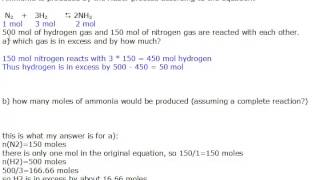
A brief worked example by Charles Collingwood solving a stoichiometry problem: given 150 mol N2 and 500 mol H2, he uses the reaction stoichiometry (N2 + 3H2 → 2NH3) to find the limiting reagent (N2), the excess amount of H2 (50 mol), and the moles of NH3 produced (300 mol).
Questions this video answers
150 moles N2 and 500 moles H2.
1 mole N2 reacts with 3 moles H2.
Nitrogen (N2) is the limiting reagent.
50 moles H2 (500 − 450).
300 moles NH3 (from 150 mol N2 → 150×2 = 300).
Chapters
Okay, let's have a look at the question put in here. The mole ratio between nitrogen and hydrogen. One mole of nitrogen will react exactly with three moles of hydrogen. Okay, let's have a look at how much nitrogen we've actually got in the question. 500 moles of hydrogen, 150 moles of nitrogen. So 150 moles of nitrogen, how much will that react with? We can see it reacts with three times the number of moles. So it reacts with three times 150, which is equal to 450 moles of hydrogen. Have we got that? Well, we've got 500. So the hydrogen is in excess. Thus hydrogen is in excess. It's in excess by. Well, the difference between PI 500 minus 450, that equals 50 moles. We could do a checksum if you want, and say, all right, well, what would happen? Let's say we look at it from the point of view of the hydrogen. Well, hydrogen, 500 moles of hydrogen would, would react with a third of that. 500 divided by 3. Just checking our calculator, 500 divided by 3, that equals 166.7. So the hydrogen, we're up with 166.7. 166.7 is more than the nitrogen gas that's there. So once again, we haven't got enough of nitrogen. So nitrogen is the limiting reagent, hydrogen is in excess, and nitrogen is the limiting reagent. We just have to ask ourselves a couple of questions to get how many moles of ammonia would be produced. Well, once again, now we just look at what actually is reacting. Well, the nitrogen is the limiting reagent. So 150 moles of nitrogen and we get double the number of moles of ammonia. So 150 molecules. Nitrogen produces 150 times 2 equals 300 moles of ammonia. So it looks like, unfortunately, you're not quite there with your answers. It.