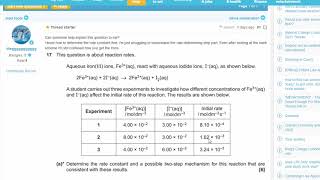
This content was created by Charles Collingwood. This content was uploaded by Charles Collingwood. This is a YouTube video titled "Rates of reaction" created on December 3, 2020, featuring Charles Collingwood explaining a chemistry concept related to reaction rates, specifically focusing on the order of reaction with respect to iron and iodide concentrations.
Chapters
Okay, we're going to do this question then about reaction rates. You're given the equation for the reaction 2, Fe3 + +2i + to give products. So what we do is we look at the experimental values for the iron 3 concentration when the iodide minus ion concentration doesn't change. So that's experiments one and two. So you'll see the effect iodine minus concentration, iodide minus rather doesn't change at all. So any effect on the rate is due to increasing the iron 3. You see, we double the iron 3 between experiment 1 and 2, and what happens is we go from 8.1 times 10 to the minus 4 up to 1.62 times 10 to the minus 3. Well, I don't know if you can see that, but that is doubling as well. So when we double the iron three, we double the initial rate. So that means the order with respect to iron 3 is 1. Now, we do the same thing with experiments 1 and 3. In experiments 1 and 3, the iron 3 is the same, but the iodide minus ion concentration doubles. Well, let's have a look at the rates. In this case, the rate goes from 8.1 times 10 to the minus 4 to 3.2 times 10 to the minus 3. Now, this is quadrupling, so it's multiplying by 4. So when we double the iron 3. Sorry. We double the iodide concentration. The rate goes up by a factor of four. So that means the order with respect to iodide is 2. So this gives us the rate equals K multiplied by the concentration of Fe3 plus multiplied by the concentration of the iodide raised to the power of two. So to determine the rate constant, you would have to rearrange that equation to give you the rate constant as the subject of the equation. So it gives you k equal the rate divided by the iron three plus concentration, multiplied by the I minus concentration squared.