Reaction profiles
Charles Collingwood explains reaction energy profiles, showing how activation energy barriers determine which step is rate-limiting. In a multi-step reaction with NO and H2, the slow step controls the overall rate, and only species in that step appear in the rate equation.
Chapters
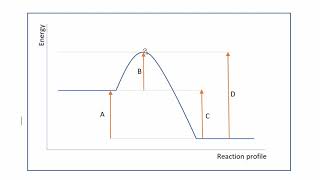
Okay, we're going to have a look at reaction profiles in terms of the energy changes that occur in the course of a chemical reaction. Now we've already looked at reaction profiles in the past, so this should be slightly familiar, but now we're going to view it from the point of view of the kinetics of the reaction as well as the thermodynamics. What you can see in front of you at the moment you should be very familiar with is the shape of the energy change in the course of an exothermic reaction. The reactants start off over here on the left hand side, and there is usually some kind of activation energy barrier to reaction, which here is marked by the energy B, the difference B between the level of the reactants over here and this extra energy needed in order for the reaction to proceed, followed by a decrease in energy to get to the products. So the difference between the reactants and the products is A in magnitude. But of course this is an exothermic reaction. And so the energy change will be, will be negative going for the reaction. So the reactants to the products will be negative and have the magnitude of the arrow A. Now, as we said, the activation energy, the energy barrier is considered to be B for the forward reaction. Now we have to appreciate that reaction profiles can go forwards or backwards. We could start with the products and work our way back to the reactants. Now it should be clear from this, in order to go from the products back to the reactants, we have to pass back over this energy barrier, this hill, if you like, this peak in energy. And in this case starting with the products, it would require D kj of energy to actually achieve the activation energy necessary to get over the barrier and into the what in this case would be the reactants. And so it's much more difficult, requires a lot more energy to go from the products to the reactants in an exothermic reaction than from the reactants to the products. Now the size of the energy barrier, the magnitude of B will determine the rate of the reaction. The higher the energy barrier, the activation energy, the slower the reaction will be. So you can see in this exothermic example, well, the rate of the reverse reaction is much slower than the rate of the forward reaction. Now this reaction is very simple. There are no steps involved. It's a one step reaction from the reactants to the products. Let's have a look what happens when we get a slightly more complex scheme. Let's move on down here. Now, in this particular case, if I can Just center it. I can't. It won't let me. There we are, we're centered. Okay. In this particular case, we've got the reactants over here. And once again, it's an exothermic reaction. We go all the way to the products over on the right hand side. But you see, there are several steps to go through. The first step requires an activation energy of A. This gets us over the first barrier. And once we get over the first barrier, we arrive at an intermediate situation. Now, this intermediate situation is more stable than a. Well, sorry, more stable than the reactants. And if we wish to go from here to the next step, we must overcome the activation energy barrier C. Now you can see the activation energy barrier C is much greater than that of A. Therefore, the reaction to get from the first intermediate here to the second intermediate will be much slower. It requires a lot more energy. However, once we've arrived at this position over in the second intermediate, well, only a small amount of energy is required for us to get to the final product. So this scheme that we're looking at here could be paralleled by our stepwise mechanism example here. If we start off with nitrogen monoxide and hydrogen, there is a rapid equilibrium to get to some point X. So we can see from our diagram down here, X would represent the situation at this first intermediate step. And it's a fast process to get from the reactants to X. Now, once we've got X, X then will react with nitrogen monoxide according to the reaction above. And you can see with nitrogen monoxide, it's a very slow step. There's a high activation energy barrier. So it's a very slow step to get over to the next intermediate point, which in this case would be Y, H2O. Finally, however, to go from this particular level here to the last stage, which is the products, it's a very rapid step. So here Y would be able to pick up or react with H2, would collide with H2, would require only a small amount of energy, and we would then be able to arrive at our final product. So we can look at energy diagrams like these and they will give us an idea as to what kind of energy changes are required to get from one step to another, what kind of energy barriers act which prevent that step, and how many stages there are in a reaction. In the scheme that you're looking at here, there is one stage from the first step to the second step, one stage from the second step to the third step, and one stage from the third step to the fourth step, so it's a three step reaction. The first activation energy is low, so it's a fast reaction. The second activation energy is high, so it's a slow reaction. The third activation energy is low, so it's a fast reaction. And so we would say that the rate determining step to go from the reactants to the products will be the second step here. And so of course, when we're producing the rate equation, we would need all of the particles that are involved in the first step, plus any extra particles required for the second step in order to produce the rate equation.










