Redox equations
Learn to write and balance half-equations for redox reactions using a four-step method: identify reactant and product, balance oxygen with water, balance hydrogen with H+, then balance charge with electrons. The tutorial works through examples like nitrite to nitrate, permanganate to Mn2+, and dichromate to Cr3+.
Chapters
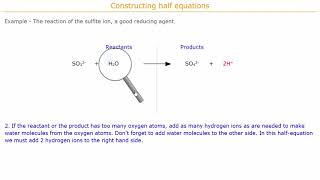
In this video we're going to have a look at half equations for reduction and oxidation processes. In the data booklet or in this data booklet, you can see that the half equations are set out as they always are. They're standard electropotentials, but they're set out as reductions. So we have the oxidized species on the left hand side which gains electrons to make the reduced species from this table. The species at the right hand side at the top are the best reducing agents. The species at the left hand side at the bottom are the best oxidizing agents. And you see that most of the redox reactions are fairly straightforward. Fe2, two electrons is in equilibrium with Fe. Well, this is easy to balance. You can see the difference between Fe2 and Fe is just two electrons. So we can balance it. The more complicated ones are the ones involving oxyions. This is the dichromate 6 ions, Cr2, O72. And although here we have it in the data booklet you have the equation half equations already balanced. I want to have a look just so you can see how we arrive at these half equations. The important thing to remember is that we do need to know the starting species and the final species that is actually oxidized or reduced. In this case, dichromate is the beginning species and the chromium 3, iron is the final species. So imagine we're having a look at this reaction of the nitrate 3, which is also called nitrite ion. It's a reducing agent. The first thing we need to identify is we need to identify what the starting material and its product would be. Well, that obviously we're told it's nitrite. Now, nitrogen has an oxidation state in the nitrite ion of 3. Its most accessible oxidizing oxidation state is 5. And in fact the nitrite iron becomes the nitrate ion. When it behaves as a reducing agent, it gets oxidized to nitrate. We want to balance this equation though. We want to balance this redox equation, we have to go through a series of steps. The first step we've identified the starting material. And the second step is to identify the fact that from no 2 minus to no 3 minus, there's been a gain of oxygen. Now, the only way we can put in oxygen is by using water. Well, we need to get three oxygens on the left hand side to balance the three oxygens on the right hand side. Now you can see here that to do that we can add in one water molecule. This provides the oxygen to balance the equation. However, it also puts in two hydrogen atoms. So we have to balance the equation again with hydrogen here to compensate for the fact we've added a water molecule and two hydrogens on the right hand side of the equation. The two hydrogen ions have to go in. So this leaves us halfway through. The problem is here. If we have a look at this equation and we count up the charges on both sides, you'll see there's a one minus charge here, no charge here. So overall, on the left hand side, there's one minus charge. Here there's one minus and two pluses. So on the right hand side, there's one plus charge. So we have more plus charges on the right hand side than the left hand side. And so what we have to do is we have to add in electrons to cancel those plus charges out. Now we need to get to one minus charge we need which is on the left hand side. So to make the one plus side into one minus, we need to add two electrons to the right hand side. And now both sides, both sides have got exactly the same charge. So we ended up with an equation which shows the same number of atoms on both sides and the same electrical charge on both sides. The equation is balanced. Let's look at the next equation. Now we want to have a look at hydrogen peroxide acting as a reducing agent, in other words, providing electrons. So the oxygen in hydrogen peroxide is in the minus 1 oxidation state. To provide electrons, it'll have to give away that electron and become oxygen in the zero oxidation state, in other words, as the element. So our first step again is to identify the starting material and its product. That's the starting material, hydrogen peroxide, and the product is oxygen. Okay, now we can see here, examining it, that there are two hydrogen atoms more on the left hand side than the right hand side. So we must add in two hydrogen ions to the right hand side. Remember, we only ever deal with hydrogen ions and water. Now, on the right hand side, we've got the right number of atoms. We've got two hydrogens, two hydrogens, two oxygens, two oxygens. It's balanced in terms of atoms. But now the left hand side has got no electric charge, whereas the right hand side has got two plus charge. There's too many charges on the right hand side. So we must add in two electrons to compensate for these two plus charges and make the whole of the right hand side neutral. And that provides us with our balanced equation. Again, hydrogen peroxide releases electrons and becomes oxygen and hydrogen ions when it behaves as a reducing agent. Another example the sulfite ion, this is also called sulfate 4. This so 3, 2. Well, when this reacts as a reducing agent, it produces the sulfate ion. So 4, 2. So we've identified the starting material and the product. Now we can see here that there are on the left hand side with the starting material here, the sulfite, there's three oxygens. On the right hand side there's four. So we have to add in one oxygen. The way we do that is by adding one water molecule. Now the consequence of adding one water molecule is that we've now got too many hydrogens on the left hand side. So we must add in two hydrogen ions to the right hand side. So our equation then is balanced in terms of atoms. But now we have to add up the charges. On the left hand side there are two negatives. On the right hand side, the two negatives are cancelled out by two positives. So there's no charges. There's two negatives on the left and zero charge. The only way we can balance this is by putting in two more electrons to the right hand side. This makes both sides have the same charge of 2 minus. The equation is balanced. This one is an organic example. This time we're going to have a look at ethanol. And when it's, we're told here, when it's fully oxidized by a strong oxidizing agent, it forms ethanoic acid. Now it's possible to partially oxidize ethanol and that would make ethanal. But in this case it's completely oxidized to ethanoic acid. So we can write our reactants and our products down. The reactant is the ethanol and the product is the ethanoic acid. Okay, so we examine these and you'll see that there on this side there are two carbons. Well, two carbons over here, carbon. There are six hydrogens and there are only four hydrogens. But forget the hydrogens, let's go straight to the oxygens. Here there's one oxygen and here there's two. So we know how to get the number of oxygens the same. We must add in a water to the left hand side. Now the consequence of adding a water molecule to the left hand side now is that we have in total we have six hydrogens here and two here we have eight hydrogens. Whereas ethanoic acid only has got four hydrogens. So we must add in four hydrogen ions. And now we're balanced in terms of atoms altogether. But you can see on the right hand side, with an overall charge of four plus and there's no charge on the left hand side. And so we must add in electrons to compensate for the extra charge on the right hand side. The extra positive charge on the right hand side. Okay, this is a very common one. The reaction of the manganate 7 ion. It's a strong oxidizing agent in acidic conditions. So we identify the starting material. Now the manganate 7 ion, which is deep purple, turns to the very pale pink manganese 2 iron. So this is our starting point. And once again let's look for the oxygen. Well, there are four oxygens here and there are no oxygens here. So the only way to get the oxygens balance is to put four water molecules over here on the right hand side. The consequence of putting four water molecules is that we've added in eight hydrogens. So they must go on the left hand side balance. Now we're balanced completely in terms of atoms. So the next job is to count up the charge on each side. Well, we've got one minus and eight pluses makes seven pluses on the left hand side and only two pluses on the right hand side. So we can compensate by reducing the positive on the left hand side by adding in five electrons. And that makes both of the sides now have got two positive charge overall. Another example, the reaction of the chlorate 1 or the hypochlorite ion. It's an oxidizing agent, a common oxidizing agent. When it oxidizes something, it takes electrons away from something. So what happens is the chlorine, which is in the plus one oxidation state, takes electrons to become chloride in the one minus oxidation state. And so once again if we examine carefully, we'll see there is one oxygen here, but there are no oxygens here. We should know by now what has to go over here to balance the number of oxygens. We need to add in a water molecule. There's our water molecule. But of course the consequence of adding the water molecule is there are two hydrogens on this side. So we need to put in two hydrogen ions on this side. Now the last stage is we count up the charge on either side. One minus and two plus is one plus one minus. So here, this side is two negatives bigger than this side, if you like. This has got one plus charge and we need to make it into a one minus charge. And we can do that by adding two electrons. So we put our two electrons in and that finishes this equation. Finally, the one we started off with, the dichromate 6 ion. We've already seen the the equation for this in the half equations on the data booklet. First steps. First, the dichromate iron becomes chromium 3. Now this is interesting because it's orange, goes to green, we get a very obvious color change in this reaction. Dichromate to chromium 3. Now, once again, let's examine. You can see there are seven oxygens here, but there are no oxygens here. And the only way to get the seven oxygens balanced is over here. I'm sure you remember, with seven water molecules. And so we put in our seven water molecules. And the consequence of having seven water molecules is 14 hydrogen ions are needed to balance the hydrogen. Now we do the count up. On this side we've got two minuses and 14 pluses, which makes 12 pluses. On this side we've only got six pluses. So we have to cancel out six of the pluses on the left hand side. And we do that with six electrons. I hope that this has been a clear way of showing you how to easily balance half equations. The most difficult thing is to know to remember what each oxidizing agent produces in terms of particles. Dichromate. Chromium 6 goes to chromium 3. There are very few we have to remember. You certainly can get this information from data booklets and any questions that you're given will give you this, almost certainly give you this information.










