Redox under alkaline conditions
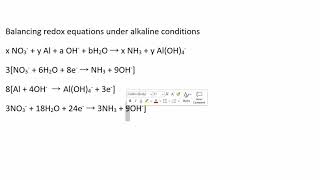
Charles Collingwood walks through balancing a redox reaction in alkaline conditions. Nitrate reduces to ammonia while aluminium oxidizes to aluminate. The final balanced equation is 3 NO3- + 18 H2O + 8 Al + 5 OH- → 3 NH3 + 8 Al(OH)4-.
Chapters
Okay, what we're going to have a look at is a way to balance this redox reaction under alkaline conditions. The first stage is to identify which species are oxidized and which are reduced. Well, we may as well start at the beginning. You can see we have nitrogen in the nitrate ion which has got an oxidation state of 5, 5 and on the right hand side we've got nitrogen, ammonia. The nitrogen's got the oxidation state of 3 minus. Remember the more electronegative species takes a negative oxidation state. So these two, there is a redox reaction that has taken place to go from nitrate to ammonia. So let's put these two species down. We'll forget little X's at the moment. Now you see here we've got, it's a bit awkward this because we're allowed to deal under alkaline conditions with water and with OH ions. Now clearly water has got one more hydrogen than oh and what we need to do is we need to add hydrogens in on the left hand side here to bind if you like with the, with the O3 minus to make water molecules. And so the way to do this is to put waters on the left hand side. So if I copy this, well I'm going to copy this equation. I take a water molecule out here, I wanted to leave the B and I'm just going to wipe that out in a moment. We'll copy this. We're going to add in water molecules, take the B out for a moment. How many water molecules do we need? Well we can see that we need to absorb these oxygens here and we need to make them into water molecules all together. The number of water molecules will be three water molecules from these three and there'll be one water molecule from every one of these. So what we want is we want three all together and on the right hand side we need three. Oh, so I'm going to copy this. Oh here, let's put that over here. Now this should have succeeded here in producing. On the left hand side we've got six hydrogens. On the right hand side we've got six hydrogens. That's right. But there's still a problem because on the left hand side we've got six oxygens as well. So in actual fact what we need to do is we need still more hydrogens from the left hand side. I want to put six in here. And now this is going to produce all together 612. And now if we put nine in here. Nine. Oh that should. How many have we got? We've got 12 hydrogens and we've got nine oxygens. So this is partially. Well, we're on the way to being correct, but there is a slight problem. The slight problem is on the left hand side we've got one negative and on the right hand side we've got nine negatives. So we need to add in eight negatives, eight electrons, eight on the left hand side to balance the half equation electronically. Okay. So it's a bit of a tricky one. Now, there was a quicker way of doing this, but I don't want to go into that because it, it doesn't, it isn't as clear. Okay. So fundamentally what we did is we had to keep adding water in order to absorb the oxygens from the nitrate. And the excess we needed, we needed three oh in excess to absorb the three oxygens here. All right, there was a bit of trial and error involved, but we can see that six water molecules on the left and nine hydroxide ions on the right. Right. Did the trick. Okay, so this gives us the one of the two half equations. Now, the other half equation is much more simple. We can see on the left hand side we've got aluminium. Let's copy aluminium there. On the right hand side we've got aluminium in the, in this species. Aloh. Four minus. Now, what's the oxidation state of the aluminium? Well, if you work it out, oh is minus, there's four minuses. Overall, there's one minus. So Al's three plus. Okay, so the change is Al to Al three plus. It's an oxidation. Right, so how do we get the 4 oh minus? Well, it's not that difficult in this case. We could just simply add in four oh minuses because we're allowed to add oh minuses. All right, so let me take the oh minus here and put it here 4. And that balances the equation in terms of atoms, but it doesn't balance the equation in terms of electrons. Here, on the left hand side there's four minuses, on the right hand side there's one. So what we need to do is we need to add three electrons to the right hand side three E minus. And that sorts the right hand side, that sorts the equation out, the half equation electronically and for atoms. Okay, so we've got our two half equations. Now then the next step is to equalize the electrons. This is quite a tricky one. Well, tricky in some respects, but you can see that the simplest factor, which 8 and 3 go into is 24. So we need to multiply the first equation here. By 3 to make 24. And I'm going to put it in square brackets like this, all right, Just to show that everything is multiplied by three. And I'm going to need to multiply the second one, put this in square brackets again by eight and that will make both of them. The electrons in both equal to 24. All right, so now it's a case of multiplying this out carefully. Now I'm going to put them down. I'm going to put it down here. Too far. Let's multiply it out. So that's three. No, three and three sixes are 18 at H2O and three eight. 24. 24 electrons and three. Multiply that by three. Multiply this by three. 27. Oh, minus. That's a horrible looking half a quote. But that's, that's the way it is. And next one, we need to multiply this out as well. We need to multiply out the aluminium half equation. So we've got eight Al. Now eight fours are 3208 aluminum oxides and 24 electrons. Right. Now the next step is we must now add our two species together. So let's just do a add together here. Add. And this is going to give me. So I'm just going to copy the left hand side of the top one. Now you'll see, first of all, we've got 24 electrons on the left hand side in the first equation. Let's block it yellow so you can see it. And we've got 24 electrons on the right hand side of the bottom equation. So when we add them together, these are going to go out. So I'm not going to select them, I'm just going to select whatever else is there. First of all, we have three. No, three plus 18H2O plus on the left hand side here we've got eight Al plus copy 32 somethings. Look at that. What's happened there? That eight's gone to a funny. I'm just going to change the font there. Why that's happened. And now we need a little arrow and the right hand side of the first equation and the right hand side of the second equation, which is 8Al. Let's add that in there. Plus and we're almost finished now. Now we just have to look to see what we can cancel out. Well, you can see. Let's go to the water. Can we cancel water out? No, they can't cancel any water out at all. Can't cancel the nitrate ions. But what we can cancel out is we can cancel some of these out. There's 32 oh minuses here and there's 27 oh minuses here. So we can completely wipe out 27 from the right and 27 from the left. So, so 27 from the right, 27 from the left leaves us 5 and that's the final balanced equation. So it looks horrible. 3. No, 3 minus plus 18h2o plus 8al plus 5 oh minus gives 3 nh. 3 plus 8al 4 minus is the final balanced redox equation. Now if you want to check it, you would have to cancel count up to count up all of the atoms and make sure that they are correct. Let's take hydrogens. There's 36 hydrogens here. That's a lot. And here there's another five. That's 41. Here three three's are nine and eight fours are 32. 32 and nine is 41. So you can see the atoms look like they're going to balance. Let's count the charges. Three minuses on the left, five minuses on the left, that's eight. Eight minuses on the left and on the right hand side, eight minuses. So the equation is correct and is balanced for both atoms and charge. It's a horrible looking equation, but just by following the process we get to the correct answer.










