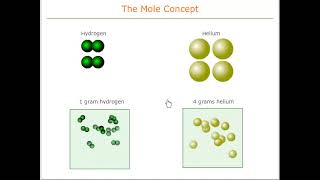
Charles Collingwood explains relative atomic mass and the mole concept. Hydrogen has a relative mass of 1, carbon 12, and magnesium 24. One mole contains about 6.0223×10^23 atoms, so 12 grams of carbon equals one mole of carbon atoms.
Questions this video answers
1.66 × 10^-24 grams.
6.64 × 10^-24 grams.
6.0223 × 10^23 (spoken as '602,230 million').
1 gram (one mole of H atoms = 1 g).
4 grams (one mole of He atoms = 4 g).
Chapters
Hi there, Chako here with a look at the mole concept. We know that the atoms are the building blocks of all matter, and the atoms come arranged in the periodic table. The smallest of all atoms is hydrogen. Hydrogen atomic number 1 has got a mass of 1.66 times 10 to the minus 24 grams. Helium atomic number 2 has got a mass of 6.64 times 10 to the minus 24 grams. Now, these masses are so incredibly small, we're never, ever going to use them. We can't weigh out one hydrogen atom. We can't weigh out one helium atom. The numbers are not much use to us, really. What's far more valuable is knowing just how many times bigger helium is. Hydrogen. A helium atom has a mass four times that of a hydrogen atom. Now, this gives us a way of discussing the relative sizes or the relative masses of all of the atoms in the periodic table. Carbon has a mass three times that of helium. Helium's got a mass of four times that of hydrogen. So carbon has a mass 12 times greater than hydrogen. We give them relative mass numbers. Hydrogen, relative mass 1. Carbon, relative mass 12. Magnesium, relative mass 24. Because magnesium is twice as big as carbon, this allows us then to assign a relative mass for every single atom in the periodic table. Calcium. It's got a relative mass of 40. It's 40 times heavier than hydrogen. Now, in reality, we use the scale based on carbon being equal exactly to 12, or in fact, one specific atom of carbon having a mass of exactly 12 relative units. So everything is compared to 12. So we really should say that hydrogen has a mass 1/12 that of carbon 12. Helium has got a mass 1/3 that of carbon 12. So helium's relative mass is 4. Magnesium has got a mass twice that of carbon 12. So magnesium's relative mass is 24. Now, if we know the relative masses of two atoms well, we also know the relative masses of groups of atoms. If we take two helium atoms, they will have four times the mass of two hydrogen atoms. If we were to take 10 helium atoms, they would have four times the mass of 10 hydrogen atoms. In other words, whenever we have four times the mass of helium as hydrogen, we must have the same number of atoms. So if we take 4 grams of helium and 1 gram of hydrogen, because 4 grams is 4 times the mass of 1 gram, there must be the same number of atoms in 4 grams as in 1 gram. Now, grams are the standard unit of measurement in a laboratory, so it makes sense to use these values. The next question is, however, how many atoms are there in Four grams of helium. Well, a man called Amadeo Avogadro worked on this problem, and he came up with an answer of 602,230 million. It's this long number here. This is the number of atoms in 4 grams of helium and also the number of atoms in one gram of hydrogen. Now, we could keep on saying 602,230 million, or we could give it a simpler name. So what we do is we call this number one mole in the same way as we call 12 a dozen sometimes. Well, this number, this huge number, Avogadro's number is simply described as one mole. So one gram of hydrogen contains one mole of hydrogen atoms. Four grams of helium contains one mole of helium atoms. And this gives us our general principle that the relative mass of any element expressed in grams contains one mole of atoms of that element. So here's our hydrogen. One gram of hydrogen has got one mole of hydrogen atoms. Four grams of helium has got one mole of helium atoms. 56 grams of iron has got one mole of iron atoms for all the periodic table. So, to summarize, then, a mole is simply a large number of particles. It is this 6.0223 times 10 to the 23 particles, which allows us to scale up from a relative mass value into a gram value. So that one carbon atom, which has got a tiny mass of 1.99 times 10 to the minus 23 grams, but a relative mass of 12. Well, if we were to multiply the actual mass by Avogadro's number, we would get 12 grams of carbon. So 12 grams of carbon contains one mole, or Avogadro's number of carbon atoms. We can extend the idea to include molecules, to include anything, electrons. Because a mole is just a big number, provided we know the relative mass of the species that we're dealing with. Well, we know that one mole of that species will have that relative mass expressed in grams. Now, hydrogen atoms normally go around in pairs. In fact, they always go around in pairs as hydrogen molecules. So the relative mass of a hydrogen molecule is 1 plus 1 equals 2. So one mole of hydrogen molecules has a mass of 2 grams. Water is made up of an oxygen atom and two hydrogen atoms. It's got a relative mass of 16 from the oxygen and two for the two hydrogens, it's got a relative mass of 18. It's 18 times heavier than one hydrogen atom. And so if we were to have one mole of water molecules, it would have an actual mass of 18 grams. One mole of water contains one mole of water molecules and has a mass of 18 grams.