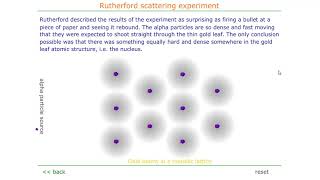
Charles Collingwood explains how Rutherford fired alpha particles at gold foil and found that most passed straight through, but some bounced backward. This proved atoms are mostly empty space with a tiny, dense nucleus about 100,000 times smaller than the atom itself.
Questions this video answers
Alpha particles (helium nuclei).
A thin gold leaf (gold foil).
About 100,000 times smaller (nucleus ≈1/100,000 of the atomic radius).
Chapters
Rutherford's scattering experiment. This was an experiment carried out by Ernst Rutherford in which he shot alpha particles through a thin gold leaf target. He expected the alpha particles to go straight through the target. But in fact, he found that a certain percentage of alpha particles were deflected through a very wide angle and some even bounced back off the target. At the time, he said this was rather like firing a bullet at a piece of paper and firing the bullet bouncing off the paper. The alpha particles were highly energetic, small helium nuclei, and he expected them to punch their way easily through the gold leaf target. So this led him to believe that the gold leaf itself, the gold atoms themselves, were mostly empty space because the particle alpha particles continued through the gold leaf. But there were some regions of very, very high density, which, if they impinged on an alpha particle, well, the alpha particle would simply bounce off them. And so this gave a picture of an atom, rather than being a consistently dense material with equal density all the way through, as being mainly empty space with a very, very dense nucleus. So this gave us our picture of the atom that we have today, Showing the animation here. This would be the alpha particles trajectory would move through the gold atoms. Now, this, even this is not to scale, of course, because the. We know now that the nuclei are something like a hundred thousand times smaller than the actual atomic radius. So effectively, you would have a small, dense nucleus really occupying a very, very, very tiny amount of volume compared to the atoms. So this was an important experiment in our development of our understanding of the structure of atoms. It allowed scientists to move away from what they called the plum pudding model, in which the atom was a relatively homogeneous object which had regions of negative and positive density embedded in a kind of plum pudding. Rutherford paved the way for our understanding of the atoms being relatively large compared to the nucleus, As I said, 100,000 times bigger than the nucleus, and that most of the atom's mass, in fact the vast majority of the atom's mass, resided in the small, dense nucleus.