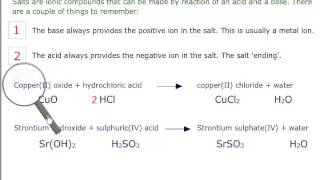
Charles Collingwood explains how salts form when acids and bases react. The base provides the positive ion, the acid provides the negative ion, and that negative ion determines the salt's name. Copper oxide plus hydrochloric acid makes copper chloride.
Questions this video answers
CuCl2
The base (the positive ion usually comes from the base).
The acid (the negative ion comes from the acid).
Sulfuric acid, H2SO4
Chapters
Okay. Formation of salts. Salts are ionic compounds that can be made by the reaction of an acid and a base. And there are a couple of things to remember here. The base always provides the positive ion in the salt. So if we were dealing with sodium chloride, sodium is the positive ion. It will come from the base. The base isn't fixed. It could be sodium hydroxide, it could be sodium oxide. It could even be sodium carbonate. A positive ion is usually a metal ion in the salt, but it could be ammonium. There are other things, compound ions or ions that are made up of several different atoms joined together, made into a positive charge. The acid. From the reaction of an acid and a base, the acid always provides the negative ion in the salt. This gives the salt ending. So sodium chloride, chloride is the ending. It must come from an acid that provides chloride ions. Now, in the first example here, we've got a base which is copper oxide, The base. And this is going to provide the metal ion for the ionic compound, copper oxide. Well, copper is the metal ion, the positive ion. So that's going to go into the salt. This is reacting with hydrochloric acid. And hydrochloric acid is going to provide the negative ion. The negative ions in hydrochloric acid are the chloride ions. So that gives us copper chloride and the formula of copper chloride, CuCl2. So we actually need to balance the hydrochloric acid with two hydrochloric acids to balance the equation. But we see the name copper chloride. The copper comes from the base, the chloride comes from the acid. So particular questions such as strontium hydroxide. Well, such as where does strontium sulfate 4 come from? Well, we know, we examine it. Strontium comes from a base which contains strontium. That could be strontium oxide, strontium hydroxide, strontium carbonate, a base containing strontium and sulfate 4. Well, that must come from an acid that provides SO3 ions. And this is H2, SO3. This goes by the name of sulfuric 4 acid. The 4 gives us the oxidation state of the sulfur strontium sulfate 4, the oxidation state of the sulfur. There's no change in oxidation states. We simply pass. The negative ion from sulfuric 4 acid goes into the salt.