Shapes of molecules and ions test
This content was created by Charles Collingwood. This content was uploaded by Charles Collingwood. This is a YouTube video titled "Shapes of molecules and ions test" created on April 6, 2020. It features Charles Collingwood providing a tutorial on how to use the IB Chemistry website to test the shapes of molecules and ions, including instructions on using Adobe Flash and explanations of molecular geometry concepts.
Chapters
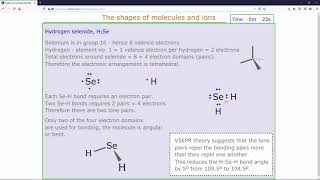
Hi there, Charco Here we're going to do a run through of the shapes of molecules test on the IB Chemistry website. And as you see, when we open the test you'll be asked to run Adobe Flash in order to get it working. So this will actually only probably work in Internet Explorer or Firefox. Chrome is a little bit more complicated and you have to actually set it up to accept Flash in every session. So recommended to use Firefox or Internet Explorer even though Internet Explorer is pretty much, pretty much gone these days. I'm in Firefox. It works fine. We just click run Adobe Flash on here and allow and that will then give us our data entry screen for the shapes and molecules and ions. So I'm going to fill my name in here, Charcoal, and my email address which is charcobchem.com and we're going to just do five questions as I'm just showing you how the test works. Click on enter and we find our test screen down the left hand side we have a whole series of radio buttons with all of the possible shapes of molecules and ions that you could be asked to find over here. Instructions. Click the question button to continue. Charcoal. Well, of course that's what I'm going to do. So use the list of shapes at the left hand side to select the shape of the molecule or ion that appears in each question on the bottom right hand side. You see we've just got an ongoing summary of how we're doing. So click on question and we have a molecule shown here. H2SE hydrogen selenide. We need to know what the shape is. While selenium is in group six or 16, it's got six outer electrons. Hydrogen provides one electron per hydrogen atom. So altogether around the selenium there are eight electrons. So this molecule is based on a tetrahedral arrangement of electron domains. There are four electron domains with eight electrons altogether and they'll be tetrahedral. However, the actual molecule itself will only occupy Use two of those electron domains for bonding the hydrogen to the selenium. And so the molecule that we end up is linear or bent. So this is what we can. Sorry, so it's a linear or bent. That was wrong. Angular or bent. Click on angular or bent and we've got a picture of the molecule down here. Now if you want a full explanation of this, we can click on the molecule as it says here says. Click on the representation above for a full explanation and this will show us exactly where we get the information from selenium group 16, hence 6 valence electrons 6, 16 or group 6 could be described in some chemistry periodic tables. This is the selenium atom. This is a hydrogen atom. This is the electronic arrangement of the Lewis structure showing the shared pairs of electrons between the selenium and the hydrogen and four electron domains, which is a tetrahedral organization. The valence shell. Electron pair repulsion theory would suggest that the lone pairs repel more than the bonding pairs. But this doesn't actually happen in selenium because selenium is a very, very large atom compared to atoms in period 2. Selenium is in period 4, 3, 4, period 4. And so in fact, the bond angle here is very close to 90 degrees. We click again here, it returns us back to the questions. Okay, so we take the next question. Beryllium dichloride. Well, beryllium's in group two. It's got two electrons only. Chlorine provides one electron to an electron pair when it bonds. So here, beryllium, the central beryllium atom, we only have four electrons. This is an electron deficient species and it forms a linear organization. They are beryllium, chlorine, chlorine, beryllium, chlorine, a linear molecule. Again, we can look at the explanation as beryllium group 2, chlorine group 17 with seven valence electrons. Each beryllium chloride chlorine bond requires an electron pair. So there are only two electron domains around the beryllium which arrange themselves as far apart as possible. It's electron deficient. This actually is only in the gaseous phase. In the solid phase, in fact, there is electron donation from chlorines to beryllium atoms in different molecules to make a lattice structure. Look at another question. Water. Well, very simple. Water is the same story as the first molecule, except this case, oxygen is much smaller than the selenium. But once again, there are four electron domains. It's a bent molecule, four electron domains, only two of them used for bonding. And there's our explanation. Hydrogen bonds by one pair of electrons, donating one and accepting one, sharing one with the oxygen, so it shares a pair altogether. In this case, there is considerable considerable repulsion by the lone pairs on the bonding pairs. So this closes this bond angle down from a perfect tetrahedral angle of 105 degrees, 28 minutes or 105.5 degrees down to 104.5 degrees. This is another molecule, sorry, iron. This time, the first time around. This is an ion. This is the PO3 3 minus. It's the phosphate 3 ion. We need to have A look at its organization of electrons. Well, phosphorus in this particular case needs to share one pair of electrons with each of the oxygens. That leaves each of the oxygens with a negative charge. The phosphorus then starts off with five electrons. It's going to have only when it shares with three oxygens. That will give it eight electrons altogether, sharing one pair with each oxygen, leaving two electrons for a lone pair. So this will be a trigonal pyramidal shape like this. Let's have a look at the explanation here. Phosphorus, There's a Lewis structure down here. Phosphorus bonds to oxygen by sharing a pair of electrons, one from the oxygen, one from the phosphorus and the phosphorus with five electrons. Then it leaves it with a lone pair. So the expected bond angle between the oxygen, phosphorus, oxygen will be similar to a tetrahedral, possibly squeezed down a little bit by the lone pair. Ammonia, nitrogen group 15. It's got five outer electrons. Each hydrogen provides one electron. That's eight electrons around the nitrogen. That's four pairs or four domains, only three of which are used for bonding. So the nitrogen ends up with a lone pair. So once again this is trigonal, pyramidal and the nitrogen is bonded to three hydrogens and it's got its lone pair on the nitrogen. This lone pair will reduce the bond angle, the HNH bond angle down to 107 degrees according to the valence shell electron pair repulsion theory. Alright, so we get the shapes of molecules and ions analysis. I was asked five questions, I gave five correct responses. That gives me a percentage of 100 and it took me six minutes and 39 seconds. If we get anything wrong they will appear down here, shapes that you need to review. And then when we send and close it, an email will be sent to charcoal so that I can review it in my email client. Ok, that was a run through of the shapes of molecules and ions. As I said, you need to activate flash in order to use it and it's oh there we go. It's just arrived in my email address. Email address. My email box says down here charcoal shapes of molecules, higher level charcoal is attempted. 5 bit blah blah blah. And it will say what I got wrong or in this case I didn't get anything wrong. Remove that and it's arrived at my other email account as well. Okay, so just a quick run through of shapes of molecules lines. There are many questions here that will cover virtually all possibilities for all syllabuses. Enjoy. Bye now. Be seeing you.










