SN1 and SN2 substitution of haloalkanes
Lecture-style explanation of nucleophilic substitution in haloalkanes distinguishing SN2 (bimolecular) and SN1 (unimolecular) mechanisms. Defines primary, secondary, and tertiary haloalkanes; explains role of halogen electronegativity creating a Cδ+ that nucleophiles attack; gives examples (hydroxide → alcohol, cyanide → nitrile). Uses kinetics (rate laws) and energy profiles to argue: primary favors SN2, tertiary favors SN1, and secondary can proceed by both.
Chapters
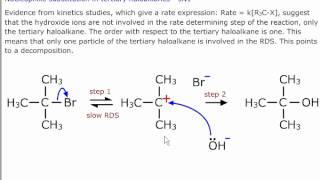
Nucleophilic substitution of haloalkanes, also called halogenoalkanes. First thing we need to know is there are three types of haloalkane. Primary, secondary and tertiary. And this is dependent upon where the halogen atom is attached to the hydrocarbon chain. When the halogen atom is attached to a carbon, which in turn is only attached to one alkyl group, then it's a primary haloalkane. In other words, the carbon that holds the halogen has one alkyl group attached. So bromoethane is a primary halogenoalkane or haloalkane. A secondary haloalkane has two alkyl groups attached to the carbon holding the halogen. So 2 bromopropane is a secondary halogenoalkane. Notice that the two here in 2 bromopropane does not indicate secondary. It tells you where the bromine atom is. The secondary is the fact that the carbon has two alkyl groups attached to the carbon holding the bromine. In the third case, the tertiary halogenoalkane, there are three alkyl groups attached to the carbon that holds the halogen. So 2 promomethylpropane is a tertiary halogenoalkane. The driving force behind euclid substitution is the electronegativity of the halogen atoms. Electronegativity means that the atoms draw electrons towards themselves along a covalent bond. This produces a dipole between the carbon and the halogen. Now, this dipole means that the carbon atom has a partial positive charge, while the halogen atom has a partial negative charge. And this partial positive charge can then be attacked by things seeking a partial positive charge. A nucleophile phial means liking or seeking, and nucleo means well, the nucleus is positive, so positive seeking. Nucleophiles have always got at least one lone pair of electrons and sometimes even a formal negative charge. Water, hydroxide ions, cyanide ions, ammonia are all common nucleophiles. The hydroxide and cyanide have formal negative charges. Now, a substitution reaction is just the same as in football. One thing substitutes another thing in the molecule. So one thing goes in and one thing goes out. In this case, the hydroxide ion substitutes the halide ion from the molecule. Examples. When hydroxide ions attack a haloalkane, we get an alcohol and a halide ion. When a cyanide ion attacks a haloalkane, we get a nitrile and a halide ion. The mechanism of the reaction shows the actual collisions that take place in Each step of the reaction. Now these are usually shown by curly arrows showing the movement of electron pairs. Electron pairs are the only things that can really move in a reaction mechanism. We get evidence for the mechanism from the reaction kinetic studies. These identify the molecularity of the slowest step, which is the rate determining step of the A process. In the case of a primary haloalkane, we find that the rate is proportional to both the haloalkane and the nucleophile. And that means that in the slower step there must be both of these particles taking place. This means that the slower step then has a collision between the nucleophile and the haloalkane. In this particular case, we could look at it as the hydroxide ion collision collides with the alkyl group or the carbon hole in the halogen. And as it moves in, the halogen moves out. Now this gives rise to a high energy transition state. And this then must fall apart further to give the halide ion and the alcohol. This doesn't have the high energy transition state, doesn't have a formal identity. It's just a logical step that when one thing goes out and another thing leaves, if they are both colliding together, well, it's a logical step that the process must go through. We can look at this in terms of a graph. The reactants, the collision. There's the hydroxide ion, the nucleophile and the haloalkane. The activation energy is the energy required to get to this transition state where both the alcohol group and the halide group or the halogen is still attached to the same hydrocarbon chain. Once that's formed, it rapidly goes to make the product the alcohol. Now, with tertiary haloalkanes, the rate mechanism, rate expression is given by rate is equal to K times the tertiary haloalkane. This suggests that there's no nucleophile involved in the slowest step. Well, the only way this could be possible is if the haloalkane itself dissociating. And so this is postulated as the slowest step dissociation by leaving the leaving of the halide ion. This gives a species with a positive charge a carbonium ion or a carbocation. Then the second stage or the second step of the reaction is attack by the nucleophile by the OH minus nucleophile, creating the tertiary alcohol. If we look at this in terms of energetics profile, first of all we have the reactant which must break apart to give the intermediate. And this requires an activation energy here between the reactant over this hump, which is the activation energy to the intermediate, then the intermediate doesn't require much activation to get to the product. Now, the reason why this intermediate has an identity is stabilized by three alkyl groups. The partial positive charge, sorry, is a formal full positive charge is spread out by the positive I effect, which means the positive inductive effect of three alkyl groups that weakens the strength of the positive charge and stabilizes the carbonium ion. So why are there different mechanisms? Well, there are two different factors involved. It's possible in theory for the tertiary haloalkanes to react via an SN2 mechanism, but the problem is there's a very high activation energy because the tertiary haloalkane is surrounded by large bulky metal groups. And that means that any attack is very difficult that raises the activation energy. On the other hand, the primary haloalkane could proceed via an SN1 mechanism and produce a carbonium ion. But this would be very high energy because it's only stabilized by one alkyl group. And so this gives us an ease of formation of carbonium ion. Tertiary, better than secondary, best than primary. But an ease of approach. Primary better than secondary, better than tertiary. So these are the two factors that are involved. Now, if we look at the three graphs for primary, secondary and tertiary, we know that the primary Mechanism goes via SN1 because. So the primary goes via SN. It doesn't go via SN1 because the SN2 mechanism has a lower activation energy as the S. As the intermediate carbonium ion will be of much higher energy. If we look at the tertiary situation, it's reversed. Tertiary goes via SN1 because the intermediate is relatively stabilized and the SN2 mechanism is relatively much higher energy because of the steric hindrance. So logically, if primary has the SN2 lower energy than the SN1 mechanism, and tertiary is the other way around, well, secondary will be a mixture of the two. In other words, a secondary haloalkane could proceed via both mechanisms. The activation energy is roughly the same regardless of the way it goes, and therefore it probably does go via both mechanisms. So as a summary, then primary haloalkanes have to collide. The particles must collide in the rate determining step. And so it's SN2 substitution, nucleophilic, bimolecular, two particle collision. Tertiary head alkanes go via SN1, and SN1 in general is a faster mechanism because the activation energy required to get to the intermediate is less. SN1 requires dissociation of the haloalkane to produce a carbonium ion, which is then attacked by a nucleophile. Secondary haloalkanes undergo substitution via both mechanisms.










