Solution Enthalpy
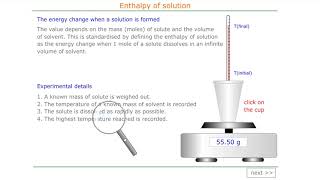
Charles Collingwood explains solution enthalpy: the energy needed to break an ionic lattice minus the energy released when ions hydrate. Measure temperature change when dissolving a solute, then calculate energy per mole. In the worked example, 5.24 g NH4Cl in water drops the temperature 6.1°C, giving ΔH of +14.4 kJ mol⁻¹.
Chapters
The enthalpy of solution is another way of saying the energy change of solution, which is the energy change when a solution is formed by dissolving a solute in a solvent. Normally the solvent is water. Now, we are usually dealing with ionic substances. And ionic substances are structures which are made up of many, many repeating oppositely charged ions. We have a look here. The ions are surrounding one another in a kind of cage where every negative ion is surrounded by positive ions. And then the structure of something like sodium chloride. You'll see we've got many, many, many, many ions, all surrounding and holding on to each other because of their opposite charges. The opposite charges attract. In order to break this ionic structure apart requires quite a lot of energy. But the energy is also odd obtained when these dissolve in water because the water particles surround the ions and make bonds with them. And so there are two different effects going on. There is the breaking apart of the ionic lattice or the ionic arrangement. And there's the energy change when the. When the ions get surrounded by water molecules. Overall, for something to be soluble in general, this must be energetically favorable. So our ionic crystal, our salt crystal, and this salt could represent any ionic salt. Here the ionic crystal breaks apart, and then each of the individual ions get surrounded by water molecules. So we have an energy change. And experimentally we can find out the energy change by dissolving a certain amount of solute in a certain mass of water and measuring the temperature change. Let's have a look at this as an example. Now, this 50.25 grams here, this represents just the mass of the water that's inside the cup. So we'll put some solute in, and we see the mass of the solute increases the mass of the container and the temperature rises. In this particular case, it's an exothermic reaction. Okay, so we need to know the mass of the solute, we need to know the initial temperature, and we need to record the highest temperature when the solute is dissolved as rapidly as possible. And then what do we do with this information? Well, the energy change, as always, is equal to the mass being heated up, which in this case is the mass of the solute and the solvent because it dissolves. So all of the mass has to be heated up. So it's the mass of the solute and the solvent together multiplied by the specific heat capacity. Here we are here, specific heat capacity multiplied by the temperature change. Now, we'll take the specific heat capacity to be the specific heat capacity of water. So that's 4.18 or there we are, there is in the example 4.18 or 4.2. All right, so we calculate the overall energy change, and then we need to know how many moles of solute have been used. And to find the moles of the solute, we have to look at the mass of the solute and divide it by its relative mass. So the mass of the solute used divided by the relative mass of that solute. And then in order to calculate the energy change per mole of solute used, we divide the actual energy we found in the first part up here. The energy change. Here we divide this by the number of moles to get the energy change per mole. So the energy change divided by the number of moles gives us the energy change per mole. So let's have a look at an example. Ammonium chloride. Ammonium chloride, which has got the formula NH4Cl, has got a relative mass of 53.45. If we dissolve 5.24 grams in 50.25 grams of water, the temperature changed from 20.2 to, to 14.1, and the total mass of the solution will be 5.25 plus 50. Sorry, 5.24 plus 50.25, which is 55.49. So our energy change, then energy change is calculated from the mass in kilograms, which is our 55.49 grams in kilograms is 0.05549, multiplied by the specific heat capacity, which is 4.18, multiplied by the temperature change, which is 6.1. And this gives us an energy change of 1.41 kilojoules. Now, this is the energy change for this mass. We need to know what the energy change would be per mole. So first of all, we have to find out how many moles there are in.25 grams. Sorry, 5.24 grams. Well, to get this, we must divide 5.24 by 53.45 to give the number of moles. So 5.24 grams is 5.24 divided by 53.45 moles, which comes to 0.98 moles. So the energy change per mole will be the energy change we had before, which was 1.41 divided by 0.098 mol, and that gives us 14.4. Now the temperature's gone down, and so it's an endothermic change, and so we must give it a positive sign. Remember, if it was an exothermic change, the solution would get hotter and we give the negative sign. So this is a representation of what's going on in terms of the actual particles Here we start off with ammonium chloride crystals. So it's this crystal lattice that needs to be broken. And we can think of it as a two stage process. We have to break it to give the individual ions, ammonium ions and chloride ions, and then we have to surround those ions by water molecules to give the ammonium ions in solution plus the chloride ions in solution. And this is then the overall process for energy of solution. As I said, the experimental side of this process is simply to dissolve a known. We must have a known mass of solute. We have to weigh out our known mass of solute. We must have. The water must have a known mass as well. So we have a total mass being heated up. We then monitor the change in temperature. So we need the initial temperature and the final temperature. And from that we can find the energy change from the mass times the specific heat capacity times the temperature change. And then if we know the mass of the solute and the relative mass of the solute, well, we can calculate the number of moles. And so by dividing the energy change by the number of moles, this will give us the energy change per mole for that particular solute.










