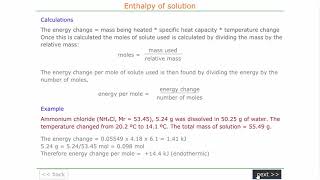
Solution enthalpy is the energy change when one mole of solute dissolves in excess solvent. Using E = mcΔT, you can calculate it from temperature change: dissolving 5.24 g NH4Cl in water drops the temperature from 20.2 °C to 14.1 °C. The process breaks down into lattice enthalpy and hydration enthalpy.
Questions this video answers
The energy change when one mole of a solute is dissolved in an effectively infinite volume of solvent.
E = m c ΔT (mass × specific heat capacity × temperature change).
5.24 grams.
50.25 grams.
Initial 20.2 °C; final 14.1 °C.
Chapters
The enthalpy of solution is also known as the enthalpy of dissolution. It's the energy change when one mole of a solute is dissolved in infinite volume of solvent. We say infinite volume of solvent. What this really means is it's dissolved in so much solvent that any further addition of solvent would not cause any change in energy. So, effectively, it's a very simple energy change. We take a solute and we put it into a known mass of solvent. Now, this will make a different mass of solution. So in this case, we have to factor in the mass of the solute when it dissolves in our our solvent. Here at the moment, we have the whole apparatus as 50.25 grams. If I'm going to add the solute, put the solute in, and then it will dissolve. As it dissolves, there will be an associated temperature change. The temperature may go up or it may go down. It's quite possible for solution enthalpy to be both negative I, in other words, exothermic or positive endothermic. If it's positive, the temperature will go down. Okay, so we need to know the mass of solute so that we can work out the moles of solute. We need to know the temperature and the initial temperature and also the final temperature. And we need to ensure that the solute is dissolved as rapidly as possible as that will limit heat losses to the environment. The calculation is fairly straightforward. As I said, we need to know the number of moles of solute that we've dissolved. So we need the mass of solute divided by the relative mass of the solute. The energy change will be, well, the energy change will be the mass being heated, which in this case will be the energy change of the whole solution, because the solute will then be dissolved in the solvent and it will make a homogeneous solution. So we multiply the mass being heated, the mass of the solution, by the specific heat capacity, by the temperature change. E equals mc delta T, as usual, to give us our energy for that particular mass or moles of solute. And then we factor in the number of moles by dividing the energy change by the number of moles to get the energy change per mole. And here's an example. If we dissolve 5.24 grams of ammonium chloride in 50.25 grams of water, the temperature changes from 20.2 to 14.1. This is an endothermic process. The total mass of the solution is 55.49. So the energy change will be the mass of the solution times the specific heat capacity times the temperature change, the mass of the solute is converted into moles. And then we divide the energy change by the number of moles to get the energy change per mole. The answer is positive because it's an endothermic process. Now, we can represent this by a Hess's law cycle. In this particular case, we've got the ammonium chloride crystals, which are a solid. We are turning the ammonium chloride crystals into a solution which contains ammonium ions and chloride ions, which are separated. Now, this can be divided up into two a energetic steps. The first step is we need to separate the solid iron ionic crystal, if you like, the solid ionic substance, into individual gaseous ions. So that steps called, in this case, Delta H2, it is the lattice enthalpy. Because we're separating all of the ions in the lattice into individual gaseous ions, then those gaseous ions need to be solvated into an aqueous solution. So in other words, each of these ions needs to be surrounded by water molecules. And we call this the enthalpy of hydration. Now, in this case, it's the enthalpy of hydration of ammonium ions and the enthalpy of hydration of chloride ions. So if we want to put this as a cycle is shown like this, that Delta H1, this process can go via Delta H2 and Delta H3. Well, then clearly Delta H1 is equal to, or the energy change of Delta H1 is equal to the energy change Delta H2 plus the energy change Delta H3. We have the equation Delta H1 equals Delta H2 plus Delta H3.