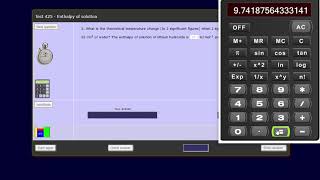
Charles Collingwood works through three enthalpy of solution problems: energy released when 1 g KBr dissolves, the temperature rise from 2.6 g LiOH in 55 cm³ water, and finding enthalpy from a 5.4 g KBr experiment. Uses mole conversions, given enthalpies, and E = mcΔT.
Chapters
Test 4.25 enthalpy of solution. We're going to have a look at a couple of questions that may arise from this. So I've got my details entered SESP and go. And let's have a look at the first question what we asked to calculate. Calculate the energy change to three significant figures when one gram of potassium bromide is dissolved, right? Okay. So we know that the total mass will be one plus 70 grams. Because one gram is one centimeter cubed. That's 71 grams or 0.0.071 kilograms. I'm just going to drop that in there. The enthalpy of solution of potassium bromide. Well, we're given the actual energy here. What we can do is we can work out the number of moles, can't we? Number of moles is one divided by 119. Actually, I didn't really need to enter this in there. Let's put this in the memory and cancel that now. So it's one divided by the relative fauna mass, which is 119. 119. And that gives us the number of moles. Here's our number of moles. And we know that we're told that the entropy of solution is 20 kilojoules per mole. So multiplied by 20 will give us actual energy. So take this, multiply it by 20, and now we have the energy that's released far less than one mole. So therefore there's far less than 20 kilojoules. It's 0.168 kilojoules. And that's the energy change that we're actually asked for, isn't it? This is the question. Calculate the energy change when 1 gram of potassium bromide is dissolved. So we just need to enter this value. 0.016, 8.168, 0.168. And that gives us our answer. Let's check the next question out. The theoretical temperature change when 2.6 grams of lithium hydroxide is dissolved in 55 centimeters cubed of water. So let's find out how many moles 2.6 grams of lithium hydroxide is. Let's call up our calculator again. Let's remove everything. So what Was the grams? 2.6. 2.6 divided by lithium hydroxide. Let's just check it out. It's 23.5 divided by 23.3.5. The number of moles is 0.11. So now we can find the energy change because the enthalpy of solution is 21.2 negative. So multiply the moles by the energy per mole. So we multiply by 21.2 equals and that tells us the total energy of this process. Now we know the mass that's being heated up and we know the specific heat capacity. So we can now work out the temperature. We have to divide this by the mass. Now the mass was 2.6 grams and 55 grams. So divide by 2.6 and 55 is 57.6 in kilograms.0576. And now we divide that by the specific heat capacity which is 4.18 and that should give us the temperature rise of 9.7 degrees. Now let's just check here. It's negative. So it will go up by 9.7 degrees. 9.7. And there's our answer. Correct. So once again it's just using E equals MC delta T. Taking care about the sign. Of course. If it's exothermic, well, the temperature will go up. If it's endothermic, the temperature will go down. Let's look at another question. 5.4 grams of potassium bromide. Right. We've got the relative mass there. 119. Let's do the first things first. Let's work out the number of moles of potassium bromide. So it's 5.4 divided by 119. 5.4 divided by 119. So there's our number of moles. And let's cancel the memory. Let's put this in the memory. We've got the number of moles there of potassium bromide. We've got the energy change here. Here's the energy change and we've got the number of moles. We can find the total energy. So the total energy minus total energy divided by the energy change show 0.908 divided by 0.98. Was it 0.98? I've forgotten that. Yeah. 0.908. 0.908 divided by memory recall. This gives us the energy change per mole which is the enthalpy solution of potassium bromide. Now let's have a look. The energy change is positive here. Alright. So the energy goes. The temperature goes down. So this will be a positive value as well. So we've got 20 as an answer. Two zero. And there's a tick. Okay, let's pause it there.