Charles Collingwood explains protons, neutrons, and electrons: their charges, masses, and positions in atoms. Learn AZE notation to find neutron count (chlorine-37 has 20 neutrons), and how isotopes differ from ions by neutron count versus electron count.
Questions this video answers
Protons, neutrons, and electrons.
About 1/100,000 of the atom's total volume.
Protons and neutrons have a relative mass of 1 unit each; electrons have a much, much smaller (negligible) mass.
4 over 2 He (written as 4/2 He).
A = 37, Z = 17, neutrons = 37 − 17 = 20.
Chapters
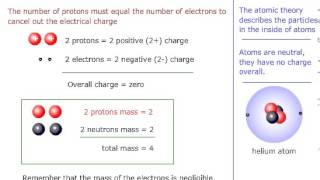
The atomic theory. Atomic theory explains to us that atoms are made up of several types of smaller subatomic particles. We call these protons, neutrons, and electrons. They are very small. In actual fact, the protons and neutrons, although they're shown here very large, only occupy around about 100,000th the volume of the total of the atom. If we have a look at the particles, you'll see the neutrons and the protons have a relative mass of one unit. Electrons have a much, much, much smaller mass. The electrons are found around the outside of the atom. Two of the subatomic particles have got charges. The protons are positive and electrons are negative. The protons are found in the nucleus. The electrons are found outside. If we have a look at the. For each atom, in this particular case, helium, the same number of electrons as there are protons. Two electrons, two protons. The charges cancel out. Neutrons themselves carry no charge. So overall, the charge on the atom is neutral. The number of protons must always equal the number of electrons to cancel out the electrical charge. Two protons, two positives, two electrons, two negatives. Overall charge is zero. The masses, however, add up. The proton masses and the neutron masses add up to give the total mass of the atom. In this particular case, the mass is 4. Remember that the mass of the electrons is negligible. We can represent the subatomic particles in an atom using the AZE system. In this, the letter A stands for the atomic mass number, Z for the atomic number, and E is the element symbol. We have a look here. A goes at the top, Z goes at the bottom, and the element symbol goes at the side. So the representation for helium would be 4 over 2He. This tells me there's a mass of 4, which is the sum of the protons and the neutrons, and that there are two protons. So if we use this system, we can easily find out the number of subatomic particles in an atom. We just look for Z, the number of protons, and that must be equal to the number of electrons, because the atom is neutral. And the mass number must be equal to the sum of the protons and neutrons. So to obtain the number of neutrons, we subtract the number of protons from the total mass. There's an example with chlorine. Chlorine has got a mass of 37, an atomic number of 17. So. So there are 17 protons and hence 17 electrons. They must always be equal to cancel out. And the number of neutrons will be 37 minus 17, which is 20 if we have an ion. An ion carries an electrical charge. So this means there must be a different number of protons and electrons. A lithium ion, for example, has got three protons. That's three positives and two negatives. You can see here there must be one more positive than negatives. So the overall charge is one plus. So a lithium ion could be represented by seven over three Li plus three protons. Overall charge of one plus therefore one more proton electron. Therefore there's two electrons. So in summary, all atoms are made up of subatomic particles. They are neutral. So the protons and electrons rather are equal. They can be represented by an AZE system. Atoms with the same element may have different numbers of neutrons and hence a different mass number. These are called isotopes. Atoms are always neutral and have the same number of protons and electrons. Ions, however, are particles formed from atoms and they do not have the same number of protons and electrons. They carry an electrical charge depending on the number of protons and electrons.