The aufbau principle
This content was created by Charles Collingwood. This content was uploaded by Charles Collingwood. This is a YouTube video titled "The aufbau principle" created on December 30, 2020, featuring Charles Collingwood explaining the Aufbau principle, a method for determining the electronic configuration of elements, and discussing related concepts such as the Pauli exclusion principle and Hund's rule.
Chapters
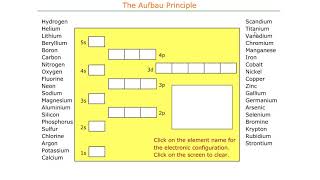
The Aufbau principle is a way of showing the electronic configuration of the elements. The name Aufbau comes from the German term which I'm not going to attempt to pronounce here, which means aufbau, or construction principle. So what we have is, have a list of the elements in order. Hydrogen, helium, lithium, ascending atomic number. Aufbau means, or tells us that we should fill up the orbitals in the ascending order of energies. So we start off with the lowest energy first. It's a bit like filling up a bucket of water. You can't fill a bucket of water from the top first you have to fill it from the bottom. So Aufbau tells us to fill the orbitals from the bottom up. Now, the electron in a box model that's shown in the screen here shows the orbitals 1s. The first energy level's got one orbital only. The second energy level has got four orbitals arranged as S&P orbitals. The third energy level has S, P and D orbitals, and then so on. With the fourth energy level as well, which also has F orbitals, we're not going to get that far. We're only interested really in the first 38, 40 or so elements here. So clearly the first electron that is going to go into the box is going to go into the lowest energy, 1s orbital. Now, the Pauli's exclusion principle tells us that we cannot have two electrons identical in all states or quantum states. And so the next electron that goes in has to take the opposite spin, so it goes to the same orbital, the lowest energy orbital with the opposite spin. So this is helium. Helium has got atomic number of two and it's got a configuration of 1s2. Now, in fact, the two there should be a superscript, but the flash program I'm using won't allow me to do a dynamic superscript. So we'll just have to pretend that's a superscript. Now, the next electron for lithium, building up to the third element number three, lithium, will go into the 2s orbital. And once again for beryllium, it will pair up to make 2s orbital. Two element number five is boron. Well, now, the next highest energy level, slightly higher energy than the S orbitals, are the 2p orbitals. Well, there are three 2p orbitals, and so Boron occupies the 2p x orbital. Now, we have a choice. The next electron for carbon could pair up in the 2px, or it could go into the 2py orbital. Now, pairing up would require more energy than going in with parallel spin. And this is known as Hundt's rule, Hunt's rule says that electrons will always enter degenerate orbitals with the same spin with parallel spin before pairing up. And so carbon's electron goes into the 2Py orbital with the same spin as the electron in the 2p x orbital. Similarly, nitrogen moves into the 2pz orbital with parallel spin. So we now have three singly occupied orbitals, the 2px, the 2py, and the 2pz. Now, the next electron will go into the 2px orbital with opposite spin to the first one, and so on with the fluorine and then neon until we have a full second shell. So now we have the electronic configuration, 1s2 2s2 2p6. Like I say, the 6 is a superscript to indicate that we're talking about the number of electrons in the P orbitals. Now, the next electron, sodium, goes into 3s, the next highest orbital, and magnesium will pair up because the 3s orbital is of lower energy than 3p. And then once again, for aluminium, we go into the three px. And silicon doesn't pair up because of Hunt's rule. It goes into 3 py and phosphorus into 3 PZ. Now the electrons start to pair up for sulfur, chlorine and argon. And that gets us to the noble gas at the end of period three. However, you'll notice here that the 3D orbitals are empty at this stage. So now we have a choice. Well, we don't have a choice. We would imagine that the next electron would go into the 3D orbital because it's in the same shell as the 3P. But by empirical evidence, this doesn't happen. The next electron enters into the 4s orbital for potassium. Now, this tells us that the 4s orbital must be of lower energy than the 3D orbitals. This is the only conclusion we can come to because we know the Aufbau principle fills up the orbitals in increasing order of energy. And the empirical evidence is that this electron is in the 4s orbital, and therefore the 4s orbital must be of lower energy. And certainly calcium, which is the next element. Element number 20 pairs that electron up. So the 4s orbital is now filled before we even start the 3d orbitals. The 3d orbitals then start with scandium, and we continue with Hundt's rule and make titanium 3D2, vanadium 3D3. Now, the next element is chromium, and something seems to have happened with chromium. The evidence is. The empirical evidence tells us that, that when we look at the electronic configuration of chromium, even though we would have expected it to be 4s23d4, something else happens. One of the s electrons appears in the 3D shell and chromium finishes the half full set of D orbitals. Now, the only reason, the only way this, this could be possible is if the 3D orbitals are now of the same energy. They are degenerate with the 4S orbital. So it seems for some reason that this particular orientation or organization of electrons has stabilized the 3D shell with respect to the 4S orbital. Because all of the orbitals are now degenerate, they all have the same energy. Let's go back to vanadium. Look at vanadium again. There's vanadium. You see, vanadium is 4s2 3d3 with 3 parallel d electrons. So we would expect the next one to be 4S2 3D4. But chromium isn't. It's anomalous. And as I said, the arrangement of electrons in the orbitals is in order of increasing energy. There is no doubt about this. There can be no doubt. The most stable orientation is that this is adopted. And therefore, when chromium comes to put its electron there, one of the electrons is removed from the 4s and goes into the 3d. And the extra electron for getting to chromium half fills that set of d orbitals. So they are slightly stabilized with respect to the 4S orbitals. So where's the next electron going to go? Well, the next electron pairs up the 4s. So which is what we would expect if all of the s and the d orbitals were indeed degenerate, we have half filled them all because they're degenerate according to Hunt's rule. And so the next one, the manganese, pairs up the 4s. And now there's no problem. We continue with iron. We pair up the electrons. We pair up the electrons to nickel, and once again we've got a situation where if we put another electron in goes from nickel to copper, we would expect that electron to go 3D4. And it does. But at the same time, an electron is transferred from the 4s into the 3d orbital. So notice now the 4s is singly occupied and the 3d orbitals are completely occupied. Well, this tells us that the 3D orbitals are lower in energy now than the 4S orbital. So it seems that the putting electrons into the 3D orbitals starts to lower their energy ever so slightly. But first of all, to bring it into line with 4s. And then even with a full set of D orbitals, it's brought the energy level of the orbitals down below that of 4S. So that makes two anomalous configurations. Chromium with a half full set of D orbitals and a half full 4s orbital and copper. Now, after that there's no problem. Zinc fills up the 4s and then we move into gallium, 4p, germanium, arsenic, selenium, bromine, krypton. And then we start the 5s process with Rubidium and strontium. Now, further up, the Aufbau principle. Once we start to fill up the 5p and then the 4d, or the 4d and 5, the Aufbau principle starts to break down. So this is a useful principle. This building up the electronic configuration from the lowest energy upwards helps us to. It's a model that helps us to write the full electronic configuration of all of the elements up to element number 38. As I said, there are two anomalous configurations that you must remember, and that's chromium and copper. Chromium has a half full set of D orbitals and a half full 4s, and copper has a full set of D orbitals and a half full 4s.










