Transcript of a short YouTube video explaining the visible portion of the hydrogen emission spectrum (the Balmer series). The narrator describes how electrons excited to higher levels relax to n=2 and emit visible photons, lists the main Balmer-line wavelengths and colors, gives the energy–wavelength relation E = hc/λ, and contrasts the Balmer series with other hydrogen series (mentions ultraviolet and infrared series).
Questions this video answers
656.3 nanometers
486.1 nanometers
434.1 nanometers
410.2 nanometers
E = hc/λ (where H is Planck's constant, c is the speed of light, λ is wavelength).
Chapters
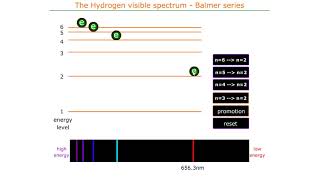
This video is about the visible portion of the hydrogen emission spectrum. This is sometimes called the Balmer series. The hydrogen emission spectrum has a series of lines in the ultraviolet, the visible and the infrared. There are several series of lines there. The lines that appear in the ultraviolet correspond to electrons relaxing down to the first energy level. But we're concerned at the moment with the second series, which is the visible spectrum of the hydrogen emission spectrum. So on the screen we see at the moment we see the, the electrons all in the ground state. This represents four separate hydrogen atoms, for example. And you can see that when the electrons have no extra energy, they reside in the N equals one level. These electrons can absorb energy by through electricity or through thermal excitation and get promoted to to different levels depending upon the amount of energy absorbed. Now, the electrons can't stay at the higher excited levels for very long. And what happens is that they will relax back to a lower energy level. They may relax back to N equals one level, in which case they will emit a photon or a quantum of energy corresponding to the difference between that level and the ground state. N equals 1. But we're concerned with what happens when the electrons relax back to the n equals 2 level. So the first electron here we see at the n equals 3 level. If that relaxes down to n equals 2, it emits a photon of visible light. And as you can see here, that visible light has a wavelength of 656.3 nanometers. This appears on the black background as a red emission line. Now, clearly, an electron that's already been promoted to n equals 4 has got more energy than an electron. N equals 3. And so when this one relaxes down to n equals 2, this emits a photon which, with a wavelength of 486.1 nanometers, the wavelength is less because the energy is more. The relationship between energy and wavelength is E equals HC over lambda, where H is Planck's constant, C is the velocity of light, and lambda is the wavelength. So as the energy increases, the wavelength gets smaller. Relaxation of an electron From n equals 5 down to n equals 2 produces a blue line, a dark blue line on the visible spectrum at 434.1 nanometers. This is very close to the violet region of the visible spectrum. And finally, we can see a line corresponds to a relaxation From n equals 6 down to n equals 2. And this produces a line at 410.2, almost in the invisible, almost in the ultraviolet. In fact, there are two lines that we can see, but one is very very faint in the visible region of the spectrum. So the hydrogen spectrum then. The visible hydrogen spectrum consists of 1, 2, 3, 4, 5 lines converging towards a high energy maximum. Now, each of these lines corresponds to an electron relaxing down to the n equals 2 energy level. So the Balmer series is the visible series. It's the second series in the hydrogen spectrum. Remember, the first series, the highest energy series, corresponds to relaxation down to N1 that appears in the ultraviolet region of the spectrum. Relaxation down to N3 is called the Lyman series, and that appears in the infrared region of the spectrum.