The electromagnetic spectrum
This content was created by Charles Collingwood. This content was uploaded by Charles Collingwood. This is a YouTube video titled "The electromagnetic spectrum" created on January 18, 2021, featuring Charles Collingwood explaining the electromagnetic spectrum, including the properties and uses of different types of electromagnetic waves from radio waves to gamma rays.
Chapters
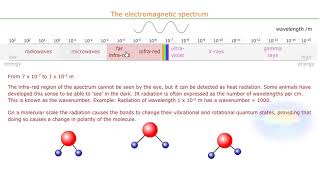
The electromagnetic spectrum shows the different frequencies or wavelengths of energy that are passed through a vacuum or through empty space. Energy is passed via waves, electromagnetic waves. These are oscillations in a magnetic sense and an electrical sense. They're at right angles to one another. We can represent them by a simple waveform. You see the waveform at the top of the diagram here? The waveform shows a sine wave. This would represent, say, the way the electrical field is oscillating, is changing from positive to negative as the energy is propagated. So electromagnetic radiation consists of waves. Those waves travel at the speed of light. All electromagnetic radiation travels at the speed of light through a vacuum, which is 2.99 times 10 to the 8 meters per second. Now, the length of the wave determines how much energy the wave is carrying. The more wavelengths that pass per second, or the greater the frequency, the more the energy. And as the speed of the wave or the speed of the wave front is consistent, it is always the speed of light. Then as we decrease the wavelength, we must increase the frequency and vice versa. So if we have a look at the longest wavelengths that we normally deal with, these are the radio waves. Now, the scale here is in meters. So 10 to the 3 represents a kilometer thousand meters. So the length of the wave, that's the distance from the crest or from any point in one wave to the same point in the next wave. Crest to crest or trough to trough is about, at this point is around about a kilometer. You'll see the radio wave range goes down to around about 10 to the naught meters, which is, of course, 10 to the naught is one. So it's a kilometer down to a meter. And if we have a look, radio waves, well, we know what we use radio waves for. They're called radio waves. Radio waves are used to pass radio information. That's the information that we get to our transistor radio, or what used to be called the wireless. With shorter wavelength and radio waves, we get to the microwave section. Now, notice there's no specific point where radio waves changes into microwaves. There's a kind of blurred region here. The microwave radiation frequencies go from around about a meter down to a thousandth of a meter micrometer, which is a thousandth of a meter. Microwaves, well, we know what they're used for. Microwaves cause the molecules themselves to change their rotational states. So there we've got an example of a hydrogen chloride molecule, for example, rotating. Well, the rotations are they can absorb energy at microwave level to increase the rotations. So if we increase the rotations in water, effectively we're giving water more energy, and that means the water will get hotter, it will vibrate more, and therefore the food contains water will heat up. So microwaves are used for heating food up. If we move into the infrared region, infrared region and the far infrared, this covers wavelengths of around about millimeter, down to 10 to the minus 7, approximately. So this region, the radiation, interacts with matter and it causes the matter to change, it change its vibrational state. We can feel this radiation. We can feel it using our sensors. Our sensors can detect a change in the vibrational nature of the molecules in our senses, and we register this as heat. So we sometimes call this heat radiation infrared radiation. Then, of course, we get the visible spectrum. Now, the visible region of the spectrum is very small compared to the whole electromagnetic spectrum. It covers the region that we can actually see, that our eyes can detect from 700 nanometers, that's 7 times 10 to the minus 7 meters, to 400 nanometers. We detect light using our eyes as different colours, from red, orange, yellow, green, blue, indigo and violet. Then beyond the visible spectrum, we get ultraviolet. We get the part of the spectrum we can't see, the ultraviolet. Now, a lot of radiation comes from the sun in the ultraviolet. And we divide it up into ultraviolet A, B and C. A is the least energy, C is the most energy. But fortunately, ultraviolet C doesn't tend to get through to the Earth's surface because of the oxygen. Ultraviolet B gets cut out because of the ozone in the. In the air, in the atmosphere. Ultraviolet A does get to the surface, and we need to protect ourselves from that by using skin block. Skin block? No sun block on our skin. Okay. Beyond the ultraviolet region, moving to even more energy, higher energy, shorter wavelength, we get X rays. And X rays tend to pass straight through matter, although they do impinge on the electrons, inner electrons, and can ionize matter. And that's why we shouldn't have too many X rays in our lives. All medicine is a balance between what's good and what's bad. And X rays are bad for us. But obviously, if we can use X rays to solve problems that we couldn't solve otherwise, well, it's useful. So we must try to avoid having too many X rays, but they are useful for medical diagnosis. Still smaller, shorter wavelength, we have gamma rays, which are even more penetrating and even more dangerous because of the amount of energy they carry. So that then comes the electromagnetic spectrum. Beyond gamma rays, we get cosmic rays, which are even shorter wavelengths and come from outer space. As I said, when we change the wavelength, we increase the wavelength, we decrease the energy and we decrease the frequency.










