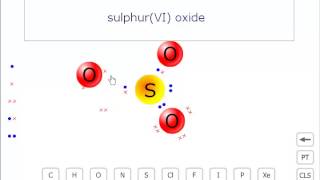
A short instructional video by Charles Collingwood explaining how to draw the Lewis structure of sulfur(VI) oxide (SO3) and using electron counting and dative bonds to satisfy octets. The video concludes that SO3 has three regions of electron density and adopts a trigonal planar molecular geometry with 120° bond angles.
Chapters
The Lewis structure and shape of sulfur 6 oxide. Sulfur 6. Oxide's got the formula, so 3. So we'll take out a sulfur and three oxygens. Now, sulfur, the main group is in group six of the periodic table. That means it's got six outer electrons. Well, let's put six, eight outer electrons there. And we'll use maybe one to share with the oxygen over here. And we use one to share with an oxygen here. And we use one to share with an oxygen here. We've just knocked an iodine onto the board and we get rid of it. Now, sulfur had six electrons altogether. It's used 1, 2, 3. If we were to put another three electrons here, we'd have three, and the six that are here would make nine. So clearly that we're going to either use octet expansion or else we're going to have to think of a different scheme for the electrons. So instead of sulfur bonding normally to this oxygen, let's put in adhesive bond. We'll let sulfur coordinate two electrons into oxygen's outer shell here. Now, this oxygen then can make use of its own six electrons to make up the full octet. There we go. So this oxygen and sulfur satisfied? So now we've got 2, 4, 6 electrons around the central sulfur, of which 1, 2, 3, 4 electrons were sulfurs. And so we can put in another two. Right. So sulfur then could have another two electrons in its outer shell here. However, if this were the case, the problem would be is that oxygen here would have 1, 2, 3, 4, 5. There's its six electrons, 2, 4, 5, 6. It's only got seven in the outer shell. So clearly there's a problem here. The way to satisfy this could be maybe take this one out completely, this pair of electrons, I mean out completely, and do the same as we did over here. Dative coordinate. The electron pair that's in sulfur into oxygen's outer shell. Oxygen then could use its six electrons. We get rid of the single electron and replace it with a pair of electrons as before, this oxygen is then satisfied. However, we've got the problem up here. Now, Sulfur's only got 1, 2, 3, 4, 5, 5, 6 electrons. It needs eight. It's got 1, 2, 3, four, five of its own. It's sharing one with oxygen. Well, that means it's got one more electron. And as coincidence happens, it just requires another pair here. And this satisfies oxygen's requirements for electrons as well. It's got its extra two electrons. So it's oxygen. 1, 2, 3, 4, 5, 6. It's satisfied. It's got an octet. This oxygen 6, this oxygen 6 and the sulfur 4, 6, 8. The full octet satisfied. There. Now, this would give three regions of electron density. This does give three regions of electron density. And that gives us a. A trigonal knot. This is the wrong shape. This will give us a trigonal planar shape like this, where the three regions of electron density run along the three prongs of the trigonal plane. The bond angle, hence then is 120 degrees. This, of course, is the Lewis structure and doesn't really represent how the bonds actually are. It's just a way of drawing the structure, fulfilling all the requirements of the electrons. So sulfur 6 oxide is trigonal planar with a bond angle of 120 degrees.