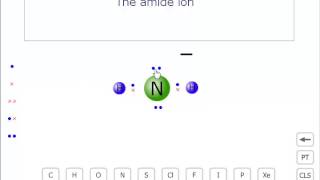
A short instructional video by Charles Collingwood explaining the Lewis structure and molecular geometry of the amide ion (NH2–). The narrator builds the Lewis structure, counts electron regions (four: two bonding, two lone pairs), applies VSEPR to predict a tetrahedral electron-pair geometry, and explains that lone-pair repulsion reduces the H–N–H bond angle from the ideal tetrahedral ~109.5° to about 104.5° (≈109°28' minus ~2.5° per lone pair).
Chapters
The amide ion, NH2. Well, we take nitrogen out onto the screen and we're going to bond it to two hydrogen atoms. Nitrogen with two hydrogen atoms. The question is, what is the shape of the amide ion using the Lewis structure? Well, each hydrogen must be bonded by a shared pair of electrons, which one of the electrons is provided by the nitrogen and one is provided by the hydrogen. However, nitrogen. If we look at the periodic table, nitrogen appears in group five. It's got five outer electrons here. We've only used two outer electrons, one. So we put in a pair of electrons, and now there are four. And so there's one more electron from the nitrogen. But the amide ion has got a negative charge. And that means if we bring in the negative charge, that negative charge must come in with another electron. And so that gives pairs up with the electron from the nitrogen. Now, this means that overall, the structure, the ion has got 1, 2, 3, 4 regions of electron density. These four regions of electron density will adopt a tetrahedral shape, And the two hydrogens will be on two prongs of the tetrahedron. We take the electron pairs down, and this is going to leave two lone pairs of electrons. Now, in fact, well, let's swap these around. Let's make this a bonding pair here and a lone pair here. I'm not going to get this shift up to one side a second. And a lone pair of electrons here. Let's bring this back in. So now we can see that then that one lone pair of electrons is going to be over here and one lone pair of electrons down here. So the actual shape of the iron, the HNH bond angle is going to be based on a bond angle of a tetrahedron. That's going to be based on a bond angle of 109 degrees, 28 minutes. But these bonds are going to be squeezed closer together by this pair, these two pairs of electrons. These exert more of a repulsive force on the bonding pairs of electrons than the bonding pair of electrons exert on each other. And in fact, normally there is about a 2 1/2 degree squeeze from each lone pair of electrons. So the bond angle of 109.5 degrees gets squeezed down to about 104.5 degrees for the amide ion.