Short video transcript explaining how to draw the Lewis structure of the triiodide ion (I3–). It counts valence electrons, places bonding and lone pairs on the central iodine (three lone pairs and two bonding pairs), identifies a trigonal bipyramidal electronic geometry, and concludes the molecular/ionic shape is linear (I–I–I, 180°).
Chapters
The Lewis structure of the triiodide ion.
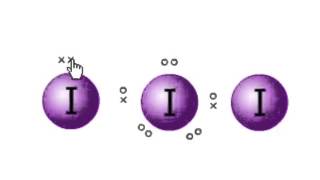
Triiodide ion has a formula I3 1 minus charge. So we need three iodine atoms. 1, 2, 3.
The iodine atoms are held together by shared pairs of electrons.
One shared pair of electrons and another.
Shared pair of electrons.
Now, the central iodine and the other iodines, all the iodines are from group.
Seven of the periodic table. That means they've got seven electrons in the outer shell. The central iodine here has used two of its seven, so it's got another five to use. But it's also got to have an extra minus here. So it needs another six electrons. Two, four. And 6, 2, 4, 6. Now, of course, the other iodine atoms have full octets.
They've used one and they've got another.
Six to add in. So we can add six more electrons.
Into each iodine to complete their octets.
Now we need to decide what the arrangement of electrons is around the central iodine. Well, there are five pairs of electrons.
Three lone pairs and two bonding pairs.
The shape adopted for five, five charge centers is trigonal bipyramidal. So we now need to decide where do the lone pairs go and where do the bonding pairs go? Well, the bond angles in the equatorial sites, that's the ones in the middle, are 120 degrees to 1 another. And this minimizes the repulsion between the lone pairs. So the three lone pairs occupy the equatorial sites. That leaves the bonding pairs in the.
Axial sites, which means that the atoms.
Are fixed in a straight line. Iodine. Iodine. Iodine. And that means that the ionic shape.
Is linear with a bond angle of 180 degrees. Remember, the electronic shape was trigonal bipyramidal.
But the ionic shape is what concerns us. The ionic shape is linear.