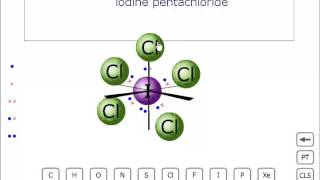
A short instructional explanation (YouTube transcript) by Charles Collingwood describing how to draw the Lewis structure for iodine pentachloride (ICl5) and determine its molecular geometry. The speaker counts valence electrons, assigns five I–Cl bonds and one lone pair on iodine, identifies six regions of electron density (octahedral arrangement) and concludes the observed shape is a slightly distorted square pyramid due to lone-pair–bonding-pair repulsion.
Chapters
The Lewis structure and shape of iodine pentachloride. Iodine, which we remember is in group seven. It's got seven electrons of its own. It's going to bond to five chlorines. We'll put the chlorines around, around the iodine, roughly evenly spaced for the moment. And each one of these requires a shared pair of electrons. Three. Bear with me a moment. Four and five. Okay, now iodine. If we count the, if we say iodine's electrons, the blue ones, there's 1, 2, 3, 4, 5. It's used, it's got two more. Now these two more will appear as a lone pair. Now that's going to mean that overall there are six regions of electron density. And those six regions of electron density then will be, will adopt a shape based on an octahedron or an octahedral orientation. So we'll bring in our octahedron. However, only five parts of the octahedron are going to have a chlorine on them. These two are further away. It's supposed to be a three dimensional representation. These two are closer together. And this last lone pair that we have down here is going to be unseeable. We cannot see it, which is fair enough. This is a three dimensional representation. Now this is going to give us a square pyramid. However, it's going to be slightly distorted. These four chlorines will be pushed up slightly with respect to the plane because of the extra repulsion of this lone pair. The lone pair bonding pair repulsion is greater than the bonding pair bonding pair repulsion. So we're going to have a slightly distorted square pyramid.