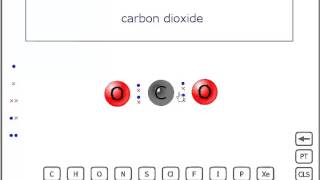
A short instructional transcript explaining the Lewis structure and molecular geometry of carbon dioxide (CO2). The speaker describes electron counts for carbon (4) and oxygen (6), formation of double bonds between carbon and each oxygen using shared electron pairs, remaining lone pairs on oxygen, and concludes that CO2 is linear with a 180° bond angle because carbon has two regions of electron density.
Chapters
The Lewis structure and shape of carbon dioxide. Carbon dioxide's got the formula carbon one, carbon two oxygens. So we take a carbon atom, carbon atoms. Carbon is in group four of the periodic table. It has four electrons of its own in its outer shell, so it's going to bond to two oxygen atoms. Each of the oxygen atoms is in group six of the periodic table. It has six electrons in the outer shell. Carbon then can bond to oxygen by means of two shared pairs of electrons. Here, one of the electrons comes from carbon and one of the electrons comes from oxygen. And here one of the electrons comes from carbon. One comes from oxygen. If we bond the other carbon and oxygen together by two pairs of electrons, this makes a double bond. We've now used up all four of carbon's electrons. Oxygen, of course, will have. Six electrons in total. So it has two more pairs. This oxygen has two more pairs, And that's the completed Lewis structure for carbon dioxide. In terms of the shape of the molecule, the carbon atom has only two regions of electron density, and these arrange themselves as far apart as possible in space. This leaves the molecule linear in shape with a bond angle of 180 degrees, and that's carbon dioxide.