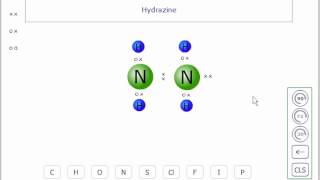
A short instructional explanation (spoken transcript) describing the Lewis structure and electron arrangement around each nitrogen in hydrazine. The speaker counts bonding and lone-pair electrons, concludes each nitrogen has four regions of electron density, and states the resulting tetrahedral arrangement and approximate bond angle (~109.28°).
Chapters
Okay, let's have a look at the structure, Lewis. Structure of the hydrazine molecule and its consequent shape. Well, hydrazine is the formula NH2. NH2. So let's pick up a couple of nitrogens, nitrogen atoms. And these two nitrogen atoms will be bonded together by a pair of electrons, one electron, of course, from each nitrogen. That leaves nitrogen with another four electrons to play with. However, each hydrogen will also provide one electron. So we're going to share a pair of electrons, one electron from the hydrogen, one electron from the nitrogen here. And we need two hydrogens per nitrogen, each of which is going to share a pair of electrons. So now if we count up, each nitrogen has used 1, 2, 3 electrons, which means that there is another two electrons on each nitrogen along a pair. Okay? So the total number of pairs of electrons, total regions of electron density, is 4 around each nitrogen. That means that the electrons are arranged tetrahedrally so that the bond angle, nitrogen, hydrogen, nitrogen, will also correspond to a tetrahedral bond angle. That would be about 109, 28. If we look at the typical shapes, four charge centers means that we have a tetrahedral arrangement. So the bond angle. Each nitrogen has a lone pair of electrons, and the bond angle corresponds to a typical tetrahedral bond angle.