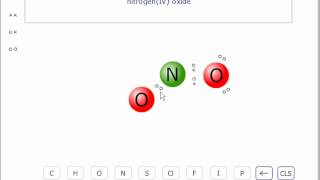
Transcript of a short instructional video by Charles Collingwood explaining the Lewis structure of nitrogen(IV) oxide (NO2). The speaker counts valence electrons (N:5, O:6 each), notes the total valence electron count is 17 (odd), describes bonding including a dative (coordinate) bond to satisfy oxygen octets, states the central N is electron-deficient with seven electrons, and gives molecular geometry as trigonal-planar-based with an experimentally/claimed bond angle of 134° (expanded from ideal 120° due to lone-pair repulsion).
Three regions of electron density; implies trigonal-planar geometry (ideal bond angle 120°).
Chapters
The Lewis structure of nitrogen 4 oxide. Nitrogen 4 oxide. It's got the formula no. 2. So we're going to need one nitrogen and two oxygens. Nitrogen is in group five. It starts off with five electrons in the outer shell, oxygen in group six. For this oxygen to be satisfied, it must share two pairs of electrons. It also has its own two pair, two lone pairs, and that makes up the eight electrons around this oxygen. This oxygen then is now satisfied with an octet, a full octet of electrons. Nitrogen has used up two of its electrons and now we have to bond the nitrogen to this oxygen. This oxygen has six electrons. There are various possibilities we could try out here. If we were to try out a double bond here, for example, with nitrogen, using two of its electrons, that would leave an extra one electron here, and that means nitrogen would have nine electrons. This isn't allowed. Therefore, we could try a single bond here. If we try a single bond here, that would mean that oxygen has used one of its electrons. Therefore it has five more left, and that would leave seven around this oxygen. Again, this is not allowed. We have to have a full octet. The only way we can get an octet around this oxygen is by taking a pair of electrons from the nitrogen and coordinating them directly into the oxygen's outer shell via a dative coordinate bond. Oxygen is then free to use its own six electrons as it wish. So oxygen then has got its own full shell of electrons, and the nitrogen now has used 1, 2, 3, 4. It has one more electron. Now, this is an unusual situation, but there is no way around it. In fact, we must have realized this was going to happen because the total number of outer electrons we had to start with was 6 for oxygen, 6 for oxygen, which is 12, and 5 for nitrogen, which is 17, an odd number. So there's always going to be an odd number of electrons somewhere. And this is the best arrangement we can have. Where the odd number lies on the central nitrogen and it has 2, 4, 6, 7 electrons. It is said to be an electron deficient molecule, electron deficient species. 1, 2, 3, 4, 5, 6, 7 electrons. Now, there are three regions of electron density around this central nitrogen. And that means that the bond angle between the oxygen, the nitrogen and the oxygen will be based on a trigonal planar bond angle. So it will be based on the bond angle of 120 degrees. However, the repulsion between the electron pairs on this oxygen and this oxygen will open the bond angle slightly. In fact, the bond angle is 134 degrees.