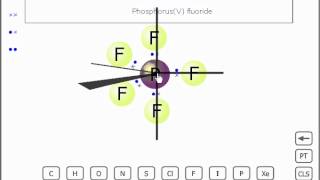
Short instructional video explaining the Lewis structure, electron counting, and molecular shape of phosphorus pentafluoride (PF5). The speaker shows PF5 has five P–F bonds (phosphorus contributes five valence electrons; each F has seven), describes filled octets for fluorines, and explains the trigonal bipyramidal geometry with 120° equatorial and 90° axial–equatorial bond angles.
Chapters
The Lewis structure and shape of phosphorus 5 fluoride. Phosphorus 5 fluoride has the formula PF5. Phosphorus is in group 5 of the periodic table, just underneath nitrogen. And so we see phosphorus has got five electrons in its outer shell. Each fluorine is bonded to the phosphorous by a shared pair of electrons. We're going to bring in five shared pairs of electrons, one for each of the fluorines. That's four fluorines, one more fluorine needed, and another shared pair of electrons. Now, we'll see that phosphorus then has used 1, 2, 3, 4. It's used all five of its outer electrons. Each of the fluorines has got seven electrons of its own. It used one, so there are six electrons, meaning that each fluorine has got a full octet. I haven't shown the full octets of electrons I could do, but it takes time, so we'll leave it as it is. Now, the next question is, how do 5 electronic electron density regions arrange themselves around a central atom? Well, the answer is this is with a trigonal bipyramidal shape. So we put this over. Let's grow it a little bit to make it easier to see. Two of the fluorines occupy axial sites that's up and down from the phosphorus. And the other three fluorines adopt positions in what's called equatorial sites. These are sites that run in a trigonal plane around the central atomic. There's a bond angle of 120 degrees between each of these central or equatorial fluorine atoms and the phosphorus. So the FPF bond angle here is 120 degrees. Between the axial fluorines and the equatorial fluorines, the bond angle is 90 degrees. So this trigonal bipyramidal shape has two different bond angles, 120 degrees and 90 degrees.