This content was created by Charles Collingwood. This content was uploaded by Charles Collingwood. This is a YouTube video titled "The Lewis structure of phosphorus(V) chloride" created on April 8, 2012, featuring Charles Collingwood explaining the chemical structure and bonding of phosphorus 5 chloride, including its trigonal bipyramidal structure and electron sharing details.
Chapters
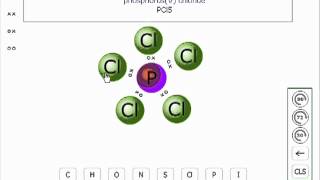
The Lewis structure of phosphorus 5 chloride has got the formula PCL5. Now, that means that the phosphorus is bonded to 5 chlorines. So we'll take 5 chlorines out onto the screen to bond to the phosphorus. Now, each of these bonds must be a shared pair of electrons. So we will share a pair of electrons. Between each phosphorous and each chlorine, Like so. Now, the phosphorous originally started off with five electrons. And if we count up the X's around here, you'll see there are five electrons. That means that each of the chlorines then has provided one electron, one. Which means that around the phosphorus there are 10 electrons. And that means that the structure adopted will be a trigonal bipyramidal structure. The phosphorus uses all of the available electrons in its bonding. In fact, it's expanded its octet. It now has 10 electrons around the central phosphorus. To completely finish the Lewis structure, we would put six more electrons around each of the chlorines, because chlorine started off with seven. And that would complete the octet of each of the chlorines as well. So phosphorus 5 chloride is trigonal bipyramidal. Remember the structures we have here. Five charge centers. 1, 2, 3, 4, 5. The five charge centers will adopt this trigonal, pyramidal or trigonal bipyramidal rather orientation. And there will be two bond angles. One of 90 degrees between the axial sites and the equatorial sites, and 120 degree angle between any two equatorial positions.