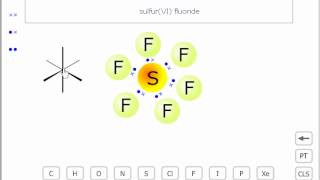
A short YouTube tutorial by Charles Collingwood explaining the Lewis structure and geometry of sulfur hexafluoride (SF6). The speaker identifies SF6 (one S, six F), notes sulfur's six valence electrons, describes six S–F single bonds (each a shared electron pair), counts six regions of electron density around sulfur, and concludes that SF6 is octahedral with 90° S–F–S bond angles (180° for opposite ligands).
Chapters
The Lewis structure of sulfur 6 fluoride sulphur. 6 fluoride has the formula SF6. So we need one sulfur atom and six fluorine atoms. Each sulfur atom, sulphur, appears in group 6 of the periodic table, and so it has six electrons in its outer shell. Each fluorine is bonded to the sulfur by one shared pair of electrons. We take six fluorines around the sulfur, drop that one down a little bit, and each one has a shared pair of electrons. One shared pair of electrons, Like so. Of course, to complete the Lewis structure, we should really put seven electrons. Seven more electrons. Sorry, six more electrons around each fluorine. However, that won't be necessary for the moment. What we're interested in now is the shape adopted by these 1, 2, 3, 4, 5, 6 regions of electron density. Well, six regions of electron density require an octahedral shape, an octahedral organization. So if we call up the octahedral axes, we would place the octahedral axes here, and each fluorine would occupy one of the positions of. On the octahedral axis, Like so. So sulfur hexafluoride then is octahedral in shape. And the bond angle then between any fluorine, sulfur fluorine bond angle must be 90 degrees. Unless, of course, we're talking about from one side to the other, in which case it would be 180 degrees. But in reality, all of the bond angles are 90 degrees. It's perfectly symmetrical and octahedral.