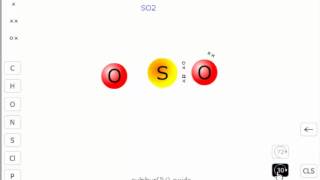
A short instructional video in which Charles Collingwood explains how to draw the Lewis structure of sulfur(IV) oxide (SO2). He counts valence electrons (18 total), places bonding pairs and lone pairs, discusses possibilities including a double bond and a dative (coordinate) bond from sulfur to one oxygen, notes sulfur can have an expanded octet, and concludes the electronic geometry is trigonal planar while the molecular shape (visible atoms) is bent (angular).
Chapters
Okay, the Lewis structure of the sulfur 4 oxide molecule. Sulfur 4 oxide has the formula SO2. So we need one sulfur and two oxygens. Sulfur is in group 6. Oxygen is in group 6. Now, this means that we have in total six valence electrons, six valence electrons and six valence electrons. Altogether we have 18 valence electrons. Well, we know that sulfur needs two electrons. Oxygen needs two electrons. So if we bond this oxygen to this sulfur by two pairs of electrons, then that will fulfill the requirement of the oxygen on the right hand side. There we go. That's fulfilled our sulfur, our oxygen requirement. Oxygen, of course, has got its own two more pairs, two lone pairs of electrons. One, two. There's two lone pairs of electrons for the oxygen. But what do we do about this oxygen? Well, this oxygen's got six electrons. Let's give it its six electrons. Two, four and six. There's six electrons, it needs eight. And sulfur has used two of its electrons. If it was to share two pairs of electrons with this oxygen, that would fulfill this oxygen and it would then give sulfur an expanded octet. It would end up with 2, 4, 6, 8, 10 electrons. Now, this is a reasonable structure because there is evidence that the sulfur oxygen bond length is less than that of a single bond, or a one and a half size bond, if you like. However, an easy way to get sulfur to provide oxygen with its requirement is to donate a pair of electrons, a dative coordinate bond, from the sulfur into the oxygens and shell. At the same time, leave sulfur with its own lone pair of electrons. Now, this structure allows all three particles to have a completed octet, sulfur double bonded to oxygen and sulfur dative coordinated to the other oxygen. Now, the molecular shape expected here, there are three regions of electron density, which means that electronically it will be trigonal planar. However, we can only see the oxygen, sulfur, oxygen. And so the actual shape is going to be sulfur, oxygen and oxygen like this, it's going to be symmetrically angular.