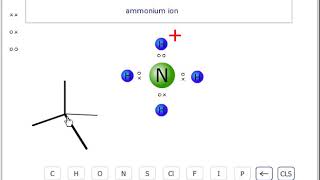
A short instructional video by Charles Collingwood explaining how to draw the Lewis structure of the ammonium ion (NH4+). The speaker walks through electron counting for nitrogen (Group 5), shows how the lone pair donates to a proton to form the dative/coordinate N–H bond producing NH4+, and notes that all four N–H bonds are equivalent. He explains VSEPR predicts four regions of electron density so the ion is tetrahedral with bond angle 109° 28′ and carries an overall positive charge delocalized over the ion.
Chapters
The Lewis structure of the ammonium ion. Ions carry a charge. So we must remember to either remove electrons if there's a positive charge or add electrons if there's a negative charge. The formula of the ammonium ion is NH4. So we take out one nitrogen, we can take out 1, 2, 3, 4 hydrogens. Now, nitrogen is in Group 5 of the periodic table. So it's got five electrons in its outer shell. That means it can provide one electron to share with a hydrogen, Another electron to share with a hydrogen, Another electron to share with the hydrogen. It's now used up three of its five electrons. It now has two more electrons. So this lone pair of electrons, which it would normally have, removing that hydrogen, can then join up with a positive hydrogen ion. It can move into this positive hydrogen proton to give the final Lewis structure of the ammonium ion. There we are. Now, the positive charge is actually spread out over the molecule, so we don't need to worry too much about that of the molecule, rather over the iron. Now, as to the actual shape of the ammonium ion, there are 1, 2, 3, 4 regions of negative charge density. So this will adopt a tetrahedral arrangement, a tetrahedral organization. We drop the tetrahedral shape over the nitrogen. You'll see that one particle can adopt. Each part of the tetrahedron. If you want to give it a bit of perspective. Here, I've lifted the wrong one. So this gives us the ammonium ion with a positive charge. And each pair of electrons is absolutely equivalent and identical. And so, even though this is a dative coordinate bond, or appears to have been formed as a dative coordinate bond, all four bonds are totally equivalent. It is a perfect tetrahedral structure with a bond angle of 109 degrees, 28 minutes.