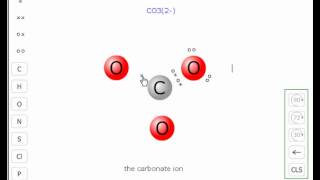
A short instructional transcript (YouTube) explaining how to construct the Lewis structure for the carbonate ion (CO3^2-). The speaker counts valence electrons (24 total), assigns bonds and lone pairs, shows one C=O double bond and two C–O single bonds in the drawn structure, and explains that in reality the three C–O bonds are equivalent; the electron-domain and molecular geometry are trigonal planar.
Chapters
The Lewis structure of the carbonate ion. Carbonate ion has the formula CO3 and carries a two negative charge. So if we're to do our accountancy, we need carbon and three oxygens. And these three oxygens. Each of these three oxygens is in group six. So the three oxygens provide six electrons each. That's 18 electrons. Carbon provides four electrons. That's 22 electrons. And we must add in two extra electrons for the two minus charge. So there are 24 electrons altogether to be added in. Now, carbon's in period two, so it can't undergo octet expansion, which means that it must be bonded to the oxygens via normal covalent bonding. So carbon can bond to one oxygen by. Two shared pairs of electrons, one. And this will fulfill the requirements of this oxygen because this oxygen has donated two of its own electrons, so it remains with four electrons. One, two, Three, four electrons. This oxygen dense has a full octet. Now, we've used up two of carbon's electrons. It only has two more electrons left, so it can share one pair of electrons with an oxygen. So we can make one bonding pair here. And now the oxygen has only got seven electrons of its own. Let's put this electron down here. Well, now let's use this. We'll add in one of the two extra electrons that we've got, because remember, we can add in two extra. We're adding in one and this oxygen. And we can do the same thing with this bottom oxygen here. We can bond using the last carbon electron. So carbon has used 1, 2, 3, 4 of its own electrons, the crosses in this case that represent the carbon's electrons. And oxygen has got 2, 4, 5 more electrons plus the one for the charge. So if we add up the total number of electrons here around this oxygen, there are 8. Around this oxygen, there are 8. And around this oxygen, there are 3, 8 are 24. So this is the structure of the carbonate ion, the Lewis structure of the carbonate ion. Of course, the actual structure will not have one double bond and two single bonds. All three carbon oxygen bonds will be equivalent in terms of the ionic shape. There are 1, 2, 3 regions of electron density around the central carbon, and so it adopts electronically a trigonal planar shape. And as there are no lone pairs of electrons, the ionic shape is also trigonal planar.